Beyond Retrospection: Architecting the Future through AI-Ready Data Products
11 min readDrraghavendra
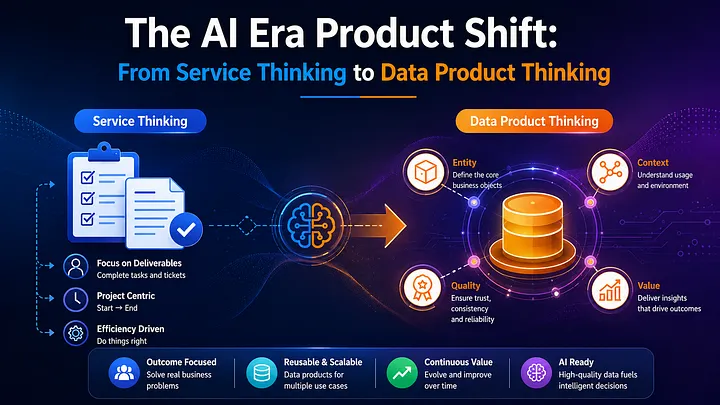
Most AI efforts still begin with the same instinct: mine historical data. Run a large language model (LLM) across existing documents, extract patterns from logs, and try to squeeze more value from what you already have. That instinct isn’t wrong — historical data is valuable — but it’s incomplete. To realize AI’s full potential, organizations must stop treating AI as a smarter archaeologist and start treating it as an engine that thrives on data intentionally created for machine reasoning: future data.
The problem with relying mainly on historical data Mining legacy data has real, immediate wins: discoverable trends, automation of repetitive tasks, and faster access to institutional knowledge. But those gains hit a ceiling driven by a simple fact: much of the richest context never made it into the record in the first place. When you build AI solutions around imperfect historical artifacts you inherit a set of structural limitations:
- Lost situational context. The “why” behind decisions — trade-offs considered, constraints present, what was out of scope — was often never recorded.
- Knowledge attrition. People who knew the reasoning leave or change roles, and tacit knowledge evaporates.
- Version ambiguity. Which version of a spec or model was used? Which dataset contributed to a result? These relationships are often unclear.
- Ownership and provenance fuzziness. Who owned a decision or a dataset? Who is accountable for errors?
- Undocumented exceptions. Edge cases and compensating controls are rarely captured reliably.
- Ambiguous systems of record. Multiple overlapping sources claim to be the truth, without clear signal of precedence.
The consequence: AI ends up doing what humans did for years — interpreting messy, incomplete information — and repeats the same guesswork at scale. That produces brittle automation, unpredictable outcomes, and hidden risk.
Why in-time context matters When data is generated, it carries more than raw values. It contains situational metadata that enables deterministic reasoning:
- Motivations: why this decision was taken.
- Alternatives considered: the options that were rejected and why.
- Expected norm vs. exception: what behavior would be considered “normal.”
- Field importance: which inputs mattered most to the decision.
- User intent: what the user actually wanted versus what they entered.
- Version linkage: which version of a policy, model, or dataset was in effect.
- Assumptions and constraints: tacit conditions that guided choices.
That context is inexpensive to capture at generation time but exponentially expensive to reconstruct later. Post-hoc enrichment becomes probabilistic for the simple reason that you’re reconstructing absent facts rather than recording them. In other words, enriching later is not enrichment — it’s inference.
Shifting focus: build systems that produce future data.To break the cycle of noisy historical inputs and brittle AI, organizations must build a data infrastructure that records context in-time — what I’ll call “future data.” Future data transforms every act of work into an opportunity for clear, machine-actionable knowledge. Here’s what that infrastructure looks like and how to get started.
Principles of future-data design
- Capture intent and provenance at source. Every data point should carry provenance (who/what created it, when) and declared intent (why it was created). This reduces downstream guessing.
- Make context first-class metadata. Instead of embedding context in free text, codify the minimal set of context fields (decision rationale, alternatives, expected outcomes, constraints).
- Record versioned objects, not snapshots. Use append-only versioning for documents, datasets, and models so every downstream observation links to a specific version.
- Treat exceptions as explicit events. Rather than overwriting or silently ignoring anomalies, log them with structured reasons and remediation actions.
- Design for human-and-machine readability. Capture context in both human-friendly summaries and structured fields that AI can consume directly.
- Enforce ownership and accountability. Associate each object and decision with an accountable owner and a stewardship lifecycle.
- Normalize schemas across lifecycle stages. Use shared vocabularies and schemas to avoid mapping hell when data moves between tools.
Concrete components to implement
- Intent-capture UIs: lightweight forms or prompts that require specifying intent, alternatives considered, and expected outcomes when users create records. Keep them minimal to avoid friction — think one sentence for intent, checkboxes for common alternatives, and a dropdown for expected criticality.
- Event-sourced records: adopt event logs or append-only stores where every change is an event with context metadata. Events keep history explicit and linkable.
- Versioned artifact registry: centralize models, policies, documents, and datasets with immutable identifiers and human summaries for each version.
- Exception catalog: a structured store describing known edge cases, mitigations, and prevalence statistics; link exceptions to the events that triggered them.
- Provenance layer and lineage graph: automatic tracking of which datasets, models, and processes created which outputs; expose lineage visually and through APIs.
- Context-rich APIs and pipelines: enforce context propagation through ETL/ELT and ML pipelines so downstream systems inherit the metadata.
- Access controls and stewardship workflows: permissions plus a workflow that ensures owners review and validate context metadata periodically.
- Lightweight annotation tools: enable inline annotation of records when humans or AI detect ambiguity, tying notes to specific versions and events.
Operational patterns that bridge behavior and tech,Technology alone won’t fix missing context. You need patterns that change human behavior:
- Make context capture default, not optional. Bake intent capture into the primary flow — if it’s optional it won’t happen.
- Incentivize short, precise rationales. Reward quick, structured context over long narratives nobody reads.
- Use templates and guided prompts. Provide domain-specific templates (e.g., finance, product, legal) that suggest the minimal fields required for useful context.
- Apply gentle guardrails. Validate required context at commit time and refuse to progress a workflow without minimal provenance.
- Automate context inference, not replacement. Use lightweight AI to suggest context (e.g., likely alternatives, relevant policies) but require human confirmation.
- Periodic stewardship reviews. Owners review high-impact objects and confirm or augment context as conditions evolve.
- Capture context where decisions happen. Integrate capture points into the tools people already use (ticketing systems, code review, model registries, contract editors).
Benefits: AI as multiplier, not reviewer When organizations capture future data, AI stops guessing and starts executing with precision. The benefits are practical and measurable:
- Lower triage and interpretation cost. Less human time spent decoding “why”; more time on value work.
- Faster, safer automation. AI can follow well-documented rationales and known exceptions rather than rely on brittle heuristic inference.
- Reproducible decisions and audit trails. Versioned, context-rich records support compliance, debugging, and post-mortem analysis.
- Reduced downstream noise. Clear intent and ownership reduce contradictory signals and conflicting automations.
- Better model training and evaluation. New models trained on context-rich data learn causal signals instead of superficial correlations.
- Quicker learning loops. When outcomes are tied to context, teams can perform targeted experiments and learn why things changed.
Common objections and how to address them
- “This will slow people down.” Keep required fields minimal and show the payoff: faster support resolution, fewer rework cycles. Use UX to make capture quick.
- “People won’t do it.” Make context capture part of existing workflows, add lightweight automation, and tie stewardship to incentives and KPIs.
- “We can reconstruct later with LLMs.” You can infer some context later, but inference is probabilistic and risky for compliance or high-stakes automation. Use LLMs as assistants, not substitutes, for provenance capture.
- “Too much metadata will clutter systems.” Only capture what’s valuable. Start with a small set of high-ROI fields and iterate.
A short playbook to start today
- Identify high-impact decision flows. Pick the areas where missing context costs you the most: audits, model-driven product decisions, compliance actions, or costly exceptions.
- Define the minimal context schema. For each flow, define 4–6 fields that would make future reasoning deterministic: intent, alternatives, owner, version, expected outcome, exception flag.
- Add intent capture to the source tool. Embed the fields into the place where decisions are made (ticket system, policy editor, model registry).
- Implement a lightweight provenance store. Use an append-only log or metadata service to store the captured context and link it to artifacts.
- Propagate context through pipelines. Ensure ETL, model training, and downstream apps carry the metadata along with the data.
- Audit and iterate. Monitor how often context fields are used for downstream decisions and refine schemas and prompts accordingly.
practical minimal context schema tailored to a model registry (fits your AI/ML and dev background). It focuses on fields that are high-ROI for capture at generation time, easy to integrate into workflows, and directly useful for reproducibility, auditing, and downstream automation.
Minimal context schema — Model Registry
Purpose: capture the core in-time context required to make model artifacts machine-actionable and auditable while keeping friction low.
Primary fields (required)
- model_id: unique immutable identifier (UUID or content-addressable hash).
- version: semantic version or monotonically increasing version string.
- created_by: user/service identifier that registered the model.
- created_at: timestamp of registration.
- intent_summary: one-sentence human summary of the model’s purpose (why it exists).
- owner: team or person accountable for model maintenance and incidents.
- provenance_link: pointer to source artifacts (training dataset IDs, preprocessing pipeline IDs, training code commit hash, experiment run ID).
Contextual fields (strongly recommended)
- primary_inputs: list of dataset IDs / input schema references used for training.
- evaluation_metrics: key metrics (name:value pairs) with evaluation dataset reference and threshold baseline.
- expected_scope: short list (comma-separated) describing intended domains, populations, or environments where model should apply.
- known_exceptions: short list (IDs or tags) for documented edge cases where model is unreliable.
- alternatives_considered: short list of other models/approaches evaluated (IDs or short names).
- decision_rationale: 1–3 sentence rationale for choosing this model/version vs alternatives.
- criticality_level: enum (low/medium/high/critical) indicating impact if model fails.
Operational metadata (optional but useful)
- training_config_ref: pointer to training hyperparameters/config file.
- compute_env_ref: identifier for environment/container image used for training.
- artifact_size: bytes; checksum.
- license_and_usage: license string and any contractual usage constraints.
- retention_policy: TTL or archival instructions.
- last_validation_at: timestamp of most recent validation run.
- stewardship_review_due: timestamp when owner should re-validate context.
Provenance & lineage (links)
- parent_model_id: if this model is a fork or fine-tune from another model.
- derived_from_datasets: list of dataset IDs with version tags.
- downstream_consumers: list of services or pipelines that consume this model (IDs).
- deployment_history_link: link to deployment records (environments, artifact IDs, timestamps).
Audit & compliance (as-needed)
- compliance_tags: list of compliance domains (e.g., GDPR, HIPAA).
- approvals: list of approval records (role, approver_id, timestamp, note).
- audit_log_ref: pointer to audit trail for changes and access.
Minimal UI/flow suggestions
- Make required fields (Primary fields + intent_summary, owner, provenance_link) part of the register-model flow; enforce with light validation.
- Use single-line inputs and dropdowns for enums to keep friction low.
- Provide smart defaults: auto-fill created_by, created_at, model_id, version candidate, compute_env_ref.
- Offer quick suggestions via automation: infer primary_inputs and training_config_ref from experiment run metadata; populate evaluation_metrics from CI test outputs.
- Keep decision_rationale optional but surfaced in review prompts for high criticality_level models.
- Enable one-click linking of dataset, code, and experiment IDs from your existing MLOps tooling.
Example (compact record)
- model_id: uuid-1234
- version: 1.0.0
- created_by: alice
- created_at: 2026–06–05T09:30:00Z
- intent_summary: “Classify customer support tickets into priority buckets for automated routing.”
- owner: support-ml-team
- provenance_link: experiment://runs/exp-9876
- primary_inputs: dataset://tickets-v3
- evaluation_metrics: accuracy:0.92 (eval://tickets-test-v1)
- expected_scope: “English, tickets from web and email channels”
- known_exceptions: “short-text, multi-language”
- alternatives_considered: “rule-based-prioritizer, logistic-reg-2025”
- decision_rationale: “Outperformed rule-based system on accuracy and latency; simpler than logistic alternative for deployment.”
- criticality_level: medium
- training_config_ref: s3://configs/ticket-classifier/2026–06–05.yaml
- compute_env_ref: docker://registry/image:ml-1.24
- last_validation_at: 2026–06–05T09:45:00Z
Illustrative example: a product-release pipeline Current approach: product specs, internal chats, and release notes live in different places. Support tickets and incident reports reference versions ambiguously. When something breaks, engineers spend hours reconstructing who approved a change and why.
Future-data approach:
- At spec creation, a one-line intent field, alternatives considered (checkboxes), owner, and version tag are recorded.
- Each code change references the spec version and includes a brief “assumption” field that lists boundaries.
- CI/CD attaches artifact IDs and environment tags to deployments.
- When an incident occurs, the system surfaces the exact spec version, the assumed inputs, and past exceptions — making root cause analysis fast and factual.
Conclusion: build for the next decade, not the last Historical mining will remain part of AI strategy, but it’s not a substitute for engineering systems that generate future-ready data. The era of AI that merely reviews what humans once did is ending. The era that starts now treats every action as a data-creating event with explicit intent, provenance, and context. That shift turns AI from an expensive reviewer into a true multiplier: more accurate automation, faster learning loops, clearer accountability, and lower risk.
More in artificial-intelligence


Cubed
Write about the technologies shaping the future.
For developers, founders, and curious minds exploring AI, crypto, Web3, and emerging tech—signal over noise.
One free account across In Plain English, Stackademic, Venture, and Cubed.
How it works- AI, crypto & Web3
- Software & emerging technologies
- Analysis & practical resources
- Thoughtful voices, not hype
Sign in
Google or GitHub
Complete profile
Takes a few minutes
Get approved & publish
Start sharing
Why write for Cubed?
The future deserves thoughtful voices, not just louder headlines.


Comments
Loading comments…