🧩 Why Configuration Becomes a Hidden Dependency (Spring Boot Reality)
2 min readakash
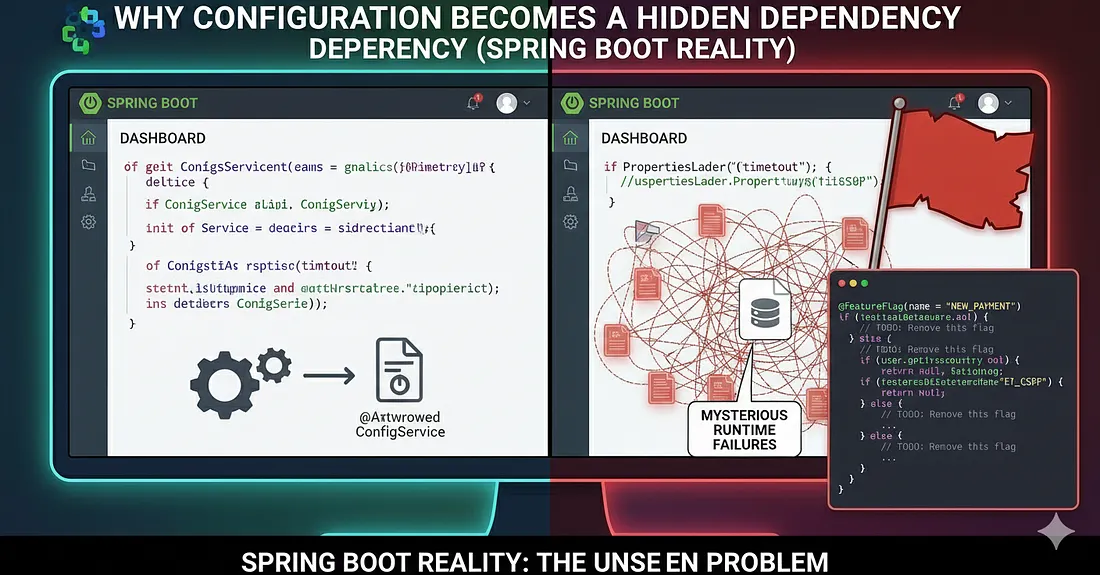
The app didn’t change.
The code wasn’t deployed.
And yet… production is broken.
Welcome to configuration-driven failures.
🚨 Configuration Is Code (But Treated Worse)
In Spring Boot, configuration decides:
- Timeouts
- Thread pools
- Feature behavior
- Memory limits
- Security rules
Yet it lives:
- Outside version control
- Without tests
- Without ownership
That’s a dependency — just invisible.
💣 The Illusion of Safety
server:
  tomcat:
    max-threads: 500
Looks harmless.
But:
- CPU can’t handle it
- DB connections cap at 50
- Latency spikes under load
No compile error. No warning. Just pain.
🔥 One Value, System-Wide Impact
Change this:
spring:
  datasource:
    hikari:
      maximum-pool-size: 100
And suddenly:
- DB slows down
- Requests queue
- Timeouts cascade
A single number rewired the entire system.
🧠 Config Changes Bypass Review Culture
Code changes go through:
- PRs
- Reviews
- Tests
Config changes?
- Slack message
- Manual edit
- Late-night hotfix
The riskiest changes are the least reviewed.
💥 Environment Drift Is Inevitable
Dev:
timeout: 5s
Prod:
timeout: 30s
Staging? Nobody knows.
Now bugs are:
- Non-reproducible
- Environment-specific
- “Works on my machine”
🧨 Dynamic Config Makes It Worse
Spring Cloud Config. Feature toggles. Runtime refresh.
Powerful? Yes.
But now:
- Behavior changes mid-request
- Threads behave differently
- State assumptions break
The app becomes non-deterministic.
⚠️ Config Dependencies Are Undocumented
New engineer asks:
“Why is this value 37?”
Answer:
“Don’t touch it — prod breaks.”
That’s tribal knowledge, not architecture.
🧠 Real Production Incidents Look Like This
- Memory leak? No.
- Deadlock? No.
- Bug? No.
Just:
“Someone changed a config.”
The worst outages don’t leave stack traces.
✅ How Senior Teams Tame Configuration
1️⃣ Version Configuration Like Code
- Git
- PR reviews
- Change history
If it affects behavior, it deserves a diff.
2️⃣ Validate Config at Startup
@ConfigurationProperties
@Validated
public class AppConfig {
    @Min(1)
    @Max(50)
    private int retryCount;
}
Fail fast. Loudly.
3️⃣ Align Environments
Same config structure. Different values — intentionally.
No surprises.
4️⃣ Document the “Why”, Not Just the “What”
# Max threads limited due to DB connection cap
max-threads: 200
Future-you will thank you.
🧠 Senior Engineer Rule
If changing config can break prod, config is a first-class dependency.
🚀 Final Takeaway
Configuration:
- Shapes runtime behavior
- Bypasses compile safety
- Outlives code changes
Ignoring it doesn’t make it safer.
It makes it dangerous in silence.
More in spring-boot
Cubed
Write about the technologies shaping the future.
For developers, founders, and curious minds exploring AI, crypto, Web3, and emerging tech—signal over noise.
One free account across In Plain English, Stackademic, Venture, and Cubed.
How it works- AI, crypto & Web3
- Software & emerging technologies
- Analysis & practical resources
- Thoughtful voices, not hype
Sign in
Google or GitHub
Complete profile
Takes a few minutes
Get approved & publish
Start sharing
Why write for Cubed?
The future deserves thoughtful voices, not just louder headlines.
Frequently Asked Questions
Common questions about this topic
What are configuration-driven failures?
Configuration-driven failures are production outages or misbehaviors caused by changes to configuration values rather than changes to application code; they often produce no compile errors or stack traces and can be hard to diagnose.
Which runtime aspects does Spring Boot configuration control?
Spring Boot configuration controls timeouts, thread pools, feature behavior, memory limits, and security rules.
Why is configuration often treated worse than code?
Configuration is often stored outside version control, lacks tests, and has no clear ownership, so it bypasses the PR, review, and test culture applied to code changes.
How can a single configuration value cause system-wide problems?
A single numerical change can rewire system behavior—for example increasing a connection pool or thread count beyond what CPU or the database can handle can cause DB slowdowns, queued requests, latency spikes, and cascading timeouts.
What does environment drift mean in the context of configuration?
Environment drift means configuration values differ across environments (e.g., development timeout 5s vs. production 30s, with staging unknown), creating non-reproducible, environment-specific bugs and 'works on my machine' problems.
How can dynamic configuration mechanisms make failures worse?
Dynamic configuration (e.g., Spring Cloud Config, feature toggles, runtime refresh) can change behavior mid-request, cause threads to behave differently, and break state assumptions, making the application non-deterministic.
Why are configuration dependencies often undocumented and risky?
Configuration dependencies are risky because their rationale and interactions are frequently tribal knowledge—engineers inherit obscure values with warnings not to touch them rather than clear architectural documentation explaining the 'why.'
What practical practices are recommended to tame configuration?
Recommended practices are: version configuration in Git with PR reviews and change history; validate configuration at startup with annotations and bounds to fail fast; align configuration structure across environments while allowing intentional value differences; and document the rationale (the 'why') for values, not just the value itself.
What does validating configuration at startup look like?
Validating configuration at startup means binding configuration to validated objects (e.g., @ConfigurationProperties with validation annotations like @Min and @Max) so the application fails fast and loudly when an invalid value would cause unsafe behavior.
What rule should senior engineers follow regarding configuration?
Senior engineers should treat any configuration that can break production as a first-class dependency, meaning it receives the same controls—versioning, review, validation, and documentation—as code.
What is the final takeaway about configuration?
Configuration shapes runtime behavior, bypasses compile-time safety, and often outlives code changes; ignoring configuration does not make systems safer but instead makes them dangerous in silence.




Comments
Loading comments…