Vibe Coding vs. Traditional Coding: Which One Should You Actually Learn?
The internet is having a heated argument about this. Most of it is missing the point entirely.
10 min readMubashir Burfat
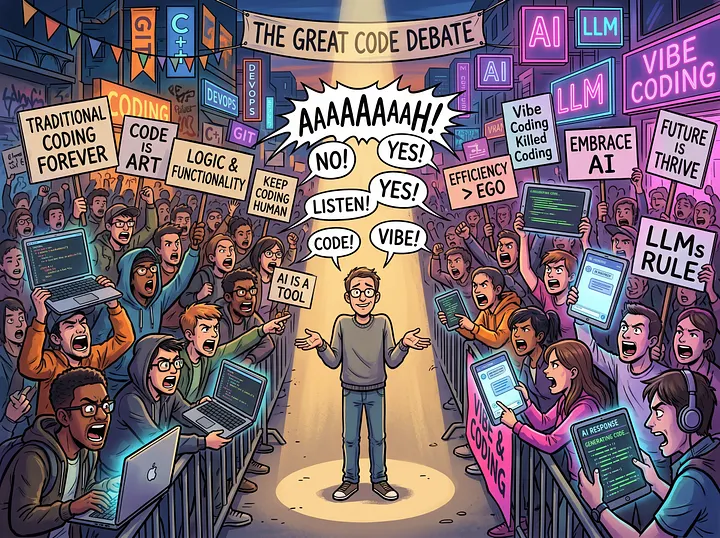
If you’ve spent any time in tech-adjacent corners of the internet recently, you’ve probably noticed that this debate has gotten genuinely heated.
On one side: people who are excited about vibe coding, the AI-assisted, describe-it-in-plain-English approach to building software, arguing that traditional coding is becoming obsolete, that anyone can build anything now, that the gates have been thrown open and the old gatekeepers can deal with it.
On the other side: experienced developers pushing back hard, arguing that vibe coding produces fragile, insecure, unmaintainable code, that people who don’t understand what they’re building are going to cause real problems, and that declaring traditional coding dead is embarrassing and naive.
Both sides are making real points. Both sides are also missing something important.
And caught in the middle of this argument is you — someone trying to figure out whether to invest time learning to code properly, lean into AI tools and skip the fundamentals, or some combination of the two that nobody has clearly defined yet.
That’s the question I want to actually answer today. Not the tribal version of it that’s happening on Twitter. The practical version, grounded in what actually serves you based on who you are and what you’re trying to build.
What Each Approach Actually Means in Practice
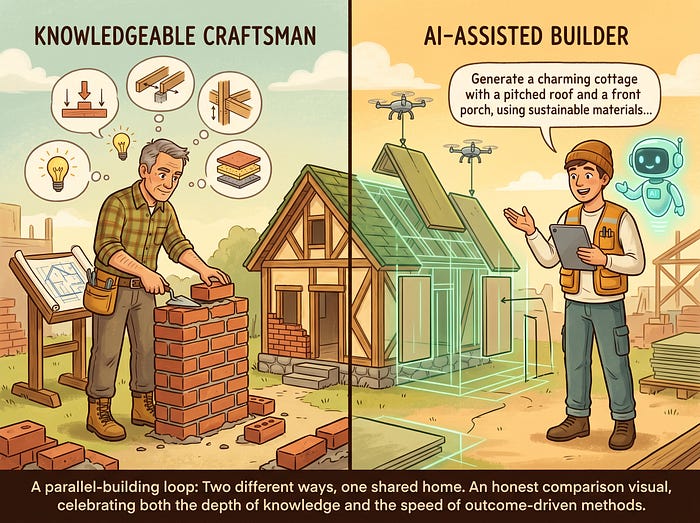
Before getting into which to choose, let’s be precise about what we’re actually comparing — because both terms get used loosely in ways that obscure more than they reveal.
Traditional coding means learning a programming language properly. Understanding the syntax, the logic, the underlying concepts. Writing code you understand line by line. Being able to debug problems because you know what the code is doing and why. Building on a foundation of knowledge that accumulates over time and applies across projects. This takes months to reach basic competence and years to reach genuine fluency. The learning curve is real, the payoff compounds significantly over time, and the depth of what you can build increases dramatically as your skills develop.
Vibe coding means using AI tools — Cursor, Claude, ChatGPT — to generate code from natural language descriptions. You describe what you want, the AI writes the code, you test whether it does what you wanted, and you iterate. You might not understand most of the code that’s generated. You’re navigating by outcome rather than by understanding. The barrier to getting something working is dramatically lower. The ceiling on complexity, for someone without underlying coding knowledge, is also lower — and the quality and maintainability of what gets built depends heavily on how much the person directing the AI actually understands.
These are genuinely different approaches with different tradeoffs. Treating them as equivalent paths to the same destination is where most of the confusion in this debate starts.
The Case for Learning Traditional Coding First
Let me make this argument properly, because it deserves more than “you need to understand the fundamentals” — which is technically true but tells you nothing useful.
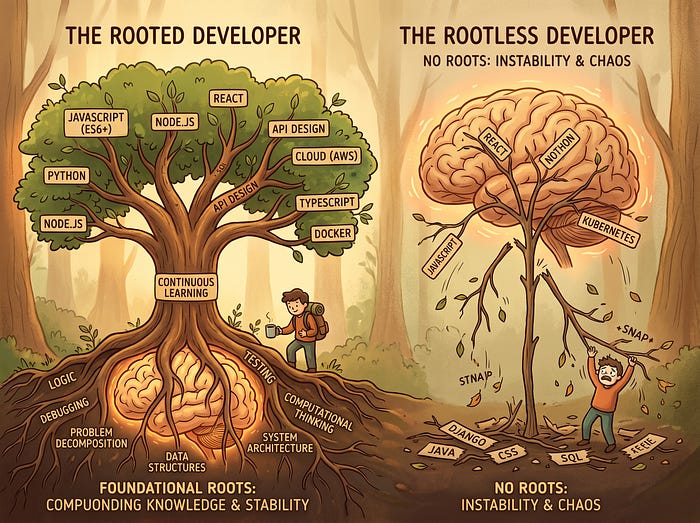
When you learn to code traditionally, you’re not just learning syntax. You’re learning how to think about problems in a specific, structured way. How to break a complex problem into smaller pieces. How to reason about what a system is doing and why. How to read an error message and understand what it’s actually telling you. How to think about edge cases — the situations your code will encounter that you didn’t explicitly design for.
This kind of thinking has value that goes well beyond the specific language you learned it in. A developer who understands programming concepts deeply can pick up a new language relatively quickly because the underlying logic transfers. They can review AI-generated code and spot problems that aren’t immediately obvious. They can architect systems that hold up as they grow in complexity. They can debug effectively when things break, which they always eventually do.
There’s also a ceiling effect worth being honest about. The things you can build with vibe coding alone — without any underlying understanding of what the code is doing — are real and genuinely useful. But they’re bounded. As projects grow more complex, as requirements become more specific, as edge cases accumulate, the person directing the AI without deep knowledge starts hitting walls that the person with genuine coding knowledge navigates past.
For anyone who wants to build software seriously — as a career, as a significant part of their freelance work, as the foundation of a product business — traditional coding knowledge is still the foundation worth building. The AI tools make you dramatically more productive once you have that foundation. They don’t replace the need for it.
The Case for Vibe Coding as a Starting Point
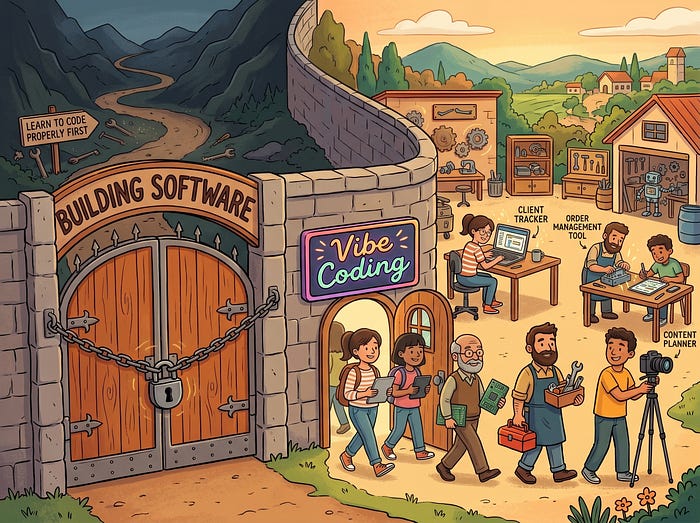
Here’s where I want to push back on the traditional coding absolutists, because the argument that everyone who wants to build things digitally should invest years in learning to code properly is not a neutral technical position. It’s a gatekeeping position, and it deserves to be challenged.
For a huge number of people — freelancers, small business owners, content creators, professionals who want to automate parts of their work — the things they need to build are genuinely not that complex. A simple internal tool. A basic automation. A small web app with a specific, limited function. A script that processes data in a specific way.
For these use cases, learning to code traditionally is a massive overinvestment. It’s like learning to be a mechanic because you want to drive a car. The skills are related in some abstract sense. They’re not the same thing, and you don’t need one to do the other.
Vibe coding gives these people genuine capability they didn’t have before. The ability to build things that previously required hiring a developer or going without. The ability to automate tasks that were eating their time. The ability to create tools tailored to their specific situation rather than bending their workflow to fit generic software.
Is the code they produce with AI assistance as good as what an experienced developer would write? Almost never. Does it matter for the use cases they’re applying it to? Often, not particularly. A small internal tool that only you use, that doesn’t handle sensitive data, that solves a specific problem you have — the code quality standards for that are very different from a customer-facing application that needs to scale and be maintained over years.
The mistake is applying enterprise software engineering standards to personal productivity tools. They’re not the same category of thing.
Who Should Actually Learn Which Thing

Let me be direct about this in a way that most articles on this topic avoid being, probably because being direct means some people won’t like the answer.
Learn traditional coding if any of these describe you. You want software development to be a significant part of how you earn a living. You’re planning to build products that other people rely on, that need to scale, that handle sensitive data, or that need to be maintained and improved over time. You find programming genuinely interesting as a craft and not just as a means to an end. You want to understand how digital systems work at a level that goes beyond using them.
Start with vibe coding if any of these describe you. You have specific, bounded things you want to build that solve real problems in your work or business. You want to prototype ideas quickly to test whether they’re worth investing in. You’re a non-developer who wants to build internal tools without hiring a developer for every small thing. You want to get something working now and figure out the deeper knowledge later if it turns out to matter.
If you’re genuinely unsure which category you’re in, here’s a useful test. Think of something specific you want to build. Open Cursor or Claude. Try to build it using natural language descriptions and see how far you get. If you hit walls that feel like they’d dissolve with deeper coding knowledge, that’s information pointing you toward traditional learning. If you get something working that serves your actual need, that’s information pointing you toward vibe coding being sufficient for now.
Experience is a better teacher than speculation about which approach you’d prefer.
The Hybrid Reality That Most People Land On
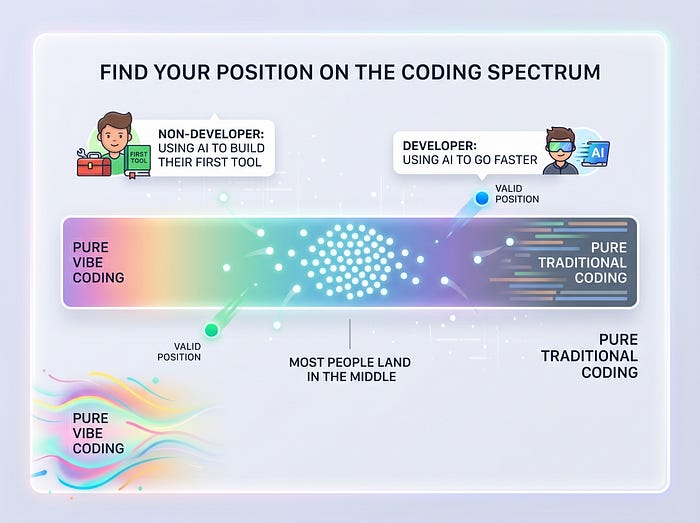
Here’s the thing that the debate online obscures because debates require clear sides: most people who build things with AI tools end up somewhere in the middle, and that middle position is actually quite coherent.
A developer with traditional coding knowledge who uses Cursor and AI assistance for implementation is doing something genuinely different from someone with no coding knowledge doing pure vibe coding. The former is using AI to go faster at something they already understand. The latter is using AI to do something they don’t understand at all. Both are valid depending on the goal, but they’re not the same thing and they don’t have the same ceiling.
The most practical path for someone starting from zero who wants real capability over time looks something like this. Start with vibe coding. Build things. Get familiar with what code looks like, what errors look like, what the AI generates in response to different kinds of prompts. You’ll absorb more than you realize just from the process of iterating and problem-solving.
Alongside that, learn some coding basics — not to become a developer, but to become a more effective director of AI coding tools. Understanding variables, functions, basic logic, how data flows through a program — this knowledge doesn’t require months of dedicated study. A focused few weeks with a beginner course gives you enough foundation to ask the AI better questions, understand its output at a higher level, and catch obvious problems before they compound.
That combination — hands-on vibe coding experience plus a working understanding of basic programming concepts — gets most non-developers to a place where they can build genuinely useful things and maintain them over time. Not to the same ceiling as a trained developer. But to a ceiling that’s high enough for most of what non-developers actually need to build.
The Question Underneath the Question
I want to end with something that doesn’t get said in most versions of this debate.
The argument about vibe coding versus traditional coding is really a proxy for a larger question about what’s worth investing your learning time in right now, when the tools are changing fast enough that the value of specific technical skills is genuinely uncertain in ways it wasn’t five years ago.
And that question doesn’t have a clean universal answer. It has a personal answer that depends on what you’re trying to build, how much of your work involves building things, how much you enjoy learning technical skills for their own sake, and what the opportunity cost of that learning time is for you specifically.
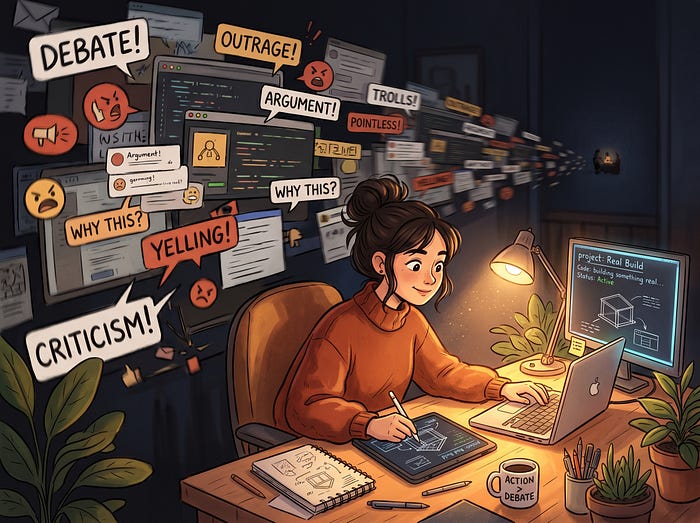
What I’d push back on, firmly, is the framing that you have to pick a side in an internet argument about this. The people arguing loudest for traditional coding being irreplaceable and the people arguing loudest for vibe coding making all prior knowledge obsolete are both overstating their case for the same reason people always overstate cases in online debates.
The reality is more boring and more useful: different tools serve different people with different goals, the landscape is genuinely evolving, and the best thing you can do is build something real with whatever approach seems most accessible to you right now and let the experience teach you what you actually need to know.
That’s less satisfying than a clear verdict. It’s also more honest.
See you in the next one.
— Mubashir :)
More in artificial-intelligence




Cubed
Write about the technologies shaping the future.
For developers, founders, and curious minds exploring AI, crypto, Web3, and emerging tech—signal over noise.
One free account across In Plain English, Stackademic, Venture, and Cubed.
How it works- AI, crypto & Web3
- Software & emerging technologies
- Analysis & practical resources
- Thoughtful voices, not hype
Sign in
Google or GitHub
Complete profile
Takes a few minutes
Get approved & publish
Start sharing
Why write for Cubed?
The future deserves thoughtful voices, not just louder headlines.


Comments
Loading comments…