Using 2extract MCP for Web Scraping Pipelines
Explore how proxies with MCP access help scraping agents manage geography, sessions, rotation, usage, and budgets. Reduce manual configuration while adding limits for reliable and cost-effective data collection.
5 min read
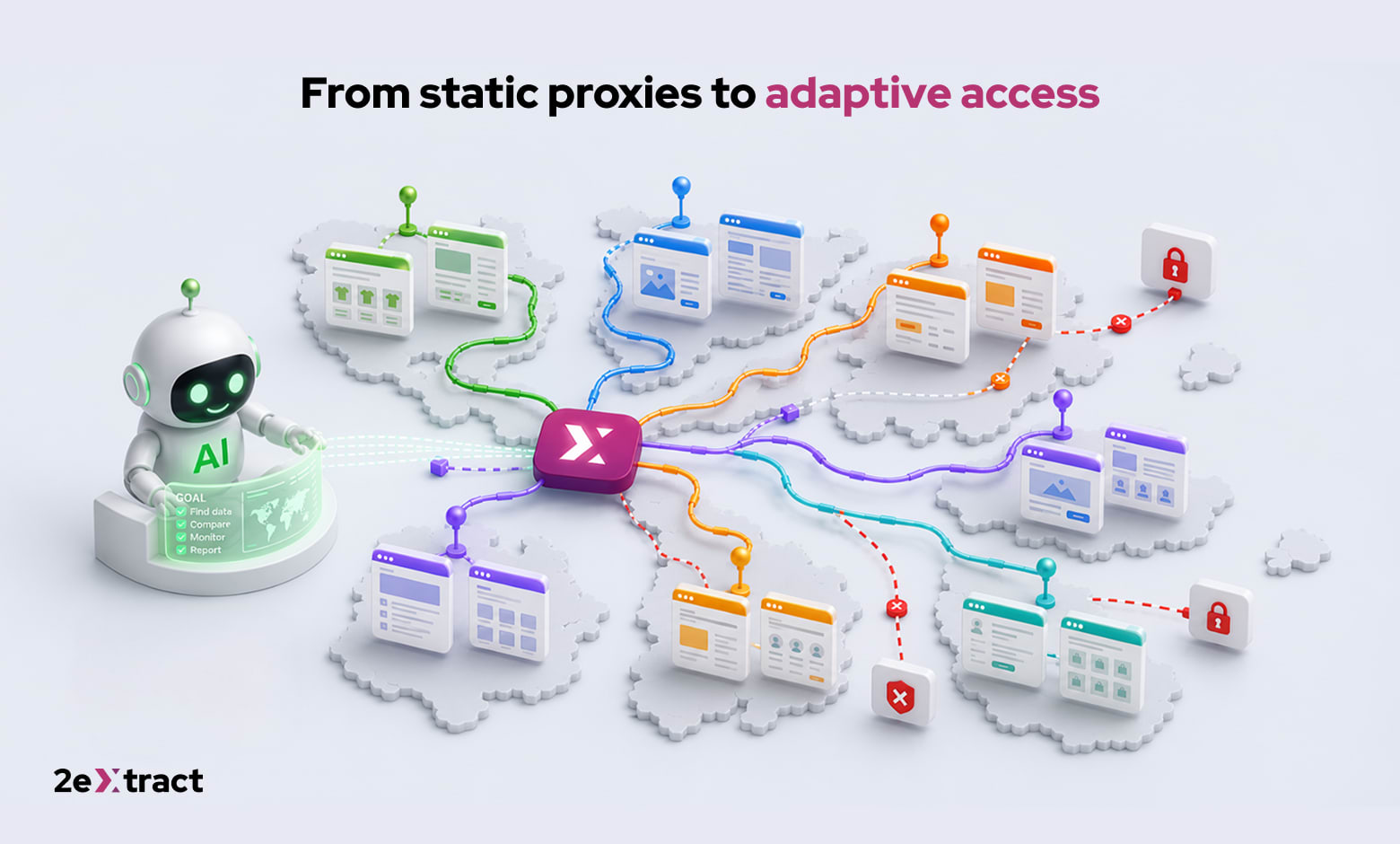 Browser use in agents has been around for about a year now: strong LLMs are already capable of opening websites, taking screenshots, extracting relevant information, and bypassing protections with proxies. This alone is not new. The real question is whether Proxy Provider's MCP can handle the transition from a controlled environment to live production.
Running a scraping agent in your interactive environment often differs from running it in live production, where it must manage connectivity, choose proxies, rotate IPs, recover from blocks, and adapt to changing target layouts.
Those decisions become difficult to automate when every credential, geography, and rotation rule has been configured in advance.
Why static proxy configuration breaks down
Traditional scrapers with fixed setups worked well because their behavior rarely changed. Agent-driven pipelines are different. A single run might need German IPs for localized pricing, US IPs for product availability checks, and sticky sessions for login flows. Trying to cover every case quickly turns into never-ending configuration work.
MCP, the Model Context Protocol, provides AI applications with a standardized way to discover and use external tools. Proxy providers that support it can expose geographic targeting, session types, rotation controls through MCP. Instead of relying on a static setup, the agent can request what it needs as the job runs.
RUNTIME · PRICE-COLLECTION · EU-RETAIL
[00:00] start · 40 retailers · DE residential
[00:14] retailer #17 → 403 Forbidden
[00:14] reroute #17 → FR rotating
[00:14] 39 other targets · collecting
[00:31] retailer #17 · recovered
In other words, you DO NOT need to edit configuration files or redeploy the pipeline every time. The agent adjusts its network access when conditions change.
2extract MCP helps agents get direct access to proxy setup, geographic targeting, usage data, and spend limits. The agent can prepare access for a specific collection task, monitor their own consumption, and remain within those limits rather than relying on another round of dashboard work.
WHEN THIS DOESN'T APPLY
Some pipelines run the same jobs against the same targets every day. In this case, fixed proxy endpoints are simpler and easier to control. Automated proxy management starts to pay off when targets, regions, and session requirements change often enough that manual configuration becomes a recurring task.
What agents need from proxies
For agent-driven scraping, the proxy layer needs to expose more than an IP pool. Agents need programmatic access to geo-targeting, session management, and rotation controls. They also need reliable feedback. If an IP address is blocked or a session expires, the system should return information that the agent can act on. Silent failures lead to bad data and are often harder to detect than explicit errors.
Concurrency matters as well. Collection pipelines usually hit many targets at once. Infrastructure that performs well for a single scraper may struggle under parallel workloads. Agents need a proxy layer that can support those demands without hidden limits or behavior that changes under load.
Runtime proxy control lowers the cost of change. Adding a new market or target involves extending the agent's objectives and the tools available to it. It no longer requires another round of configuration edits and releases.
Imagine a product-monitoring agent that needs to scrape prices from a national German retailer whose catalogue changes by city. To make it harder (and more interesting), imagine that its page layout changes daily. The agent can resolve the location it needs, create a proxy resource for that job, and set a traffic or spend limit before collection starts. When the task is done, it can report the usage tied to that resource, so the team can see what the expansion actually cost instead of treating network access as invisible infrastructure.
Guardrails
That freedom needs boundaries. Region restrictions, retry limits, and per-job budgets help keep costs under control. Giving agents access to proxy controls without guardrails is an easy way to turn a small problem into an expensive one.
Feedback deserves as much attention as access controls. Agents need to know whether they are dealing with a temporary block, a permanent ban, or a slow target. Without that information, they can end up repeating the same failed requests or switching proxies when the problem lies elsewhere.
A temporary campaign agent may create proxies for its own jobs and read their usage, while broader account changes remain outside its access. A fixed limit gives it room to recover from normal failures but prevents a bad retry loop from turning a small collection task into an open-ended expense.
Choosing a provider
Geographic targeting, rotating and sticky sessions, usage data, and session controls should all be available through interfaces that agents can discover and call directly. If teams have to build translation layers or bolt on observability themselves, the integration will cost more than it first appears.
Price also needs context. A cheaper network can become expensive if it frequently blocks requests or requires engineers to keep maintaining configuration glue. The more useful question is how much collection work the system can perform on its own and how much operational effort it still demands.
Common mistakes
Teams often make the same mistakes:
- They give agents unrestricted proxy access without deciding which pipelines actually need it.
- They blame proxies for failures caused by broken parsers or rendering issues.
- They automate collection but skip observability. If you cannot trace which proxy decisions agents made and which choices improved outcomes, you are operating largely by guesswork.
Closing thoughts
In agent-driven pipelines, proxies are increasingly integrated into the runtime environment rather than treated as background infrastructure. The practical question is how much network control agents should have and what limits should govern that control. Systems that answer those questions well can adapt to changing targets without turning every new requirement into another configuration project.
To try this in a real pipeline, connect 2extract MCP to your favorite MCP client and use it for one small, capped collection job. Check usage afterward, then decide whether it belongs in a broader workflow.
More in web-scraping
Cubed
Write about the technologies shaping the future.
For developers, founders, and curious minds exploring AI, crypto, Web3, and emerging tech—signal over noise.
One free account across In Plain English, Stackademic, Venture, and Cubed.
How it works- AI, crypto & Web3
- Software & emerging technologies
- Analysis & practical resources
- Thoughtful voices, not hype
Sign in
Google or GitHub
Complete profile
Takes a few minutes
Get approved & publish
Start sharing
Why write for Cubed?
The future deserves thoughtful voices, not just louder headlines.


Comments
Loading comments…