Tools Smarter Than ChatGPT? Top 2026 Alternatives for Real Work
6 min readAnkita Deo
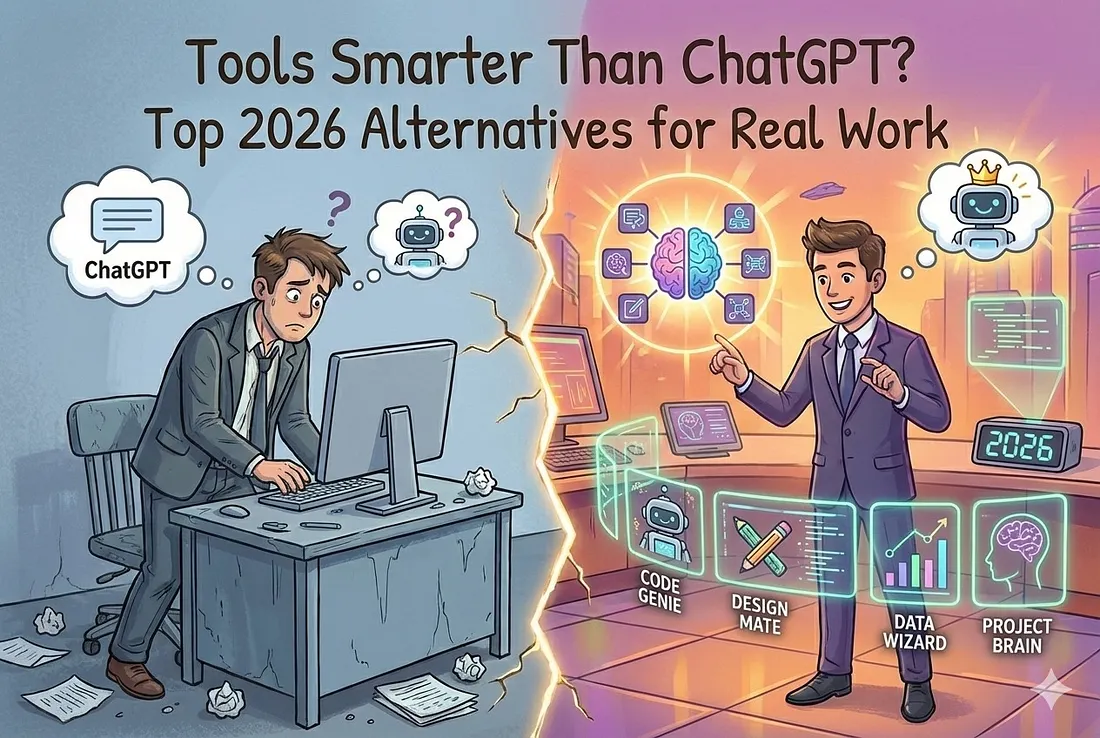
Artificial Intelligence in 2026 has evolved beyond using a single chatbot solution for all tasks. Professionals in the field now create AI stacks by selecting various tools that they need for their writing, coding, research, automation, and privacy work.
The generalist capabilities of ChatGPT remain strong, but specialized AI platforms currently show better results for actual productivity needs. The AI market now presents multiple distinct products that range from enterprise reasoning systems to research assistants and region-specific localized AI solutions.
The top ChatGPT alternatives that will emerge in 2026 will show us how work should be performed in modern workplaces.
Why Professionals Are Moving Beyond One AI Tool
Your training includes data up to the month of October in the year 2023. The research demonstrates that Large Language Models (LLMs) possess advanced capabilities, yet they show deficiencies in three areas, which include their ability to reason, their capacity to verify facts, and their knowledge of specific fields. The study discovered that major models performed well in procedural tasks, yet their systems displayed unpredictable conceptual reasoning abilities, which demonstrated the requirement for human monitoring and specialized instruments.
The evaluations showed that AI chatbots produced incomplete or fake references which created dangers when researchers used the technology without critical evaluation in academic and research environments.
Organizations now move away from using a single AI system for all tasks to adopting specific AI systems that match their particular needs.
1. Claude: The Enterprise Reasoning Powerhouse
Anthropic’s Claude family has become one of the strongest rivals to ChatGPT, especially in corporate environments. It is widely recognized for handling long documents, complex reasoning, and compliance-heavy workflows.
Key advantages include:
- Massive context windows (up to hundreds of thousands of tokens) for analyzing long reports or contracts.
- Strong performance in coding, analytics, and multi-step workflows.
- Integrations with tools like Slack, Notion, and Google Workspace for enterprise collaboration.
Recent updates even introduced faster response modes to improve efficiency for reasoning-heavy and software-development tasks.
Best for: Strategy teams, legal analysis, research-heavy roles.
2. Google Gemini: The Multimodal Work Assistant
Google’s Gemini ecosystem is designed to work across text, images, audio, and video making it a strong alternative for organizations embedded in the Google workspace.
- Built for multimodal understanding and real-time integrations.
- Deep connections with Google tools enhance research, collaboration, and productivity workflows.
Google is also pushing AI-assisted development tools that automate bug fixes and multi-step coding workflows, signaling a deeper move into enterprise automation.
Best for: Teams already using Google Workspace or needing multimodal capabilities.
3. Microsoft Copilot: AI That Lives Inside Your Workflow
Microsoft Copilot focuses less on conversation and more on embedded productivity.
- Works directly inside Word, Excel, Teams, and PowerPoint to assist with in-document tasks.
- Provides real-time code generation and contextual recommendations for developers.
Microsoft has also expanded Copilot to support multiple AI models, including Claude, reflecting a broader multi-model future.
Best for: Corporate professionals and developers using Microsoft ecosystems daily.
4. Perplexity: The Research-Centric AI
Perplexity positions itself as an AI-powered search engine rather than a conversational assistant.
- Delivers answers by summarizing and citing web sources directly.
- Designed for quick, verifiable research rather than long-form conversation.
Many users prefer it for fact-checking and live information retrieval instead of relying on static AI knowledge.
Best for: Analysts, researchers, journalists, and students.
5. Jasper AI: Built for Marketing and Content Teams
Unlike general AI assistants, Jasper is optimized specifically for marketing workflows.
- Generates blog posts, ads, and campaigns aligned to brand voice.
- Integrates with platforms like HubSpot and WordPress for seamless publishing pipelines.
This specialization often makes it more efficient than ChatGPT for structured content production.
Best for: Marketing teams, agencies, and brand managers.
6. Duck.ai: Privacy-First AI Access to Multiple Models
Duck.ai (from DuckDuckGo) offers something unique: access to multiple AI models while emphasizing privacy.
- Users can interact anonymously with different LLMs without prompts being stored or used for training.
- Conversations are stored locally on devices, reducing data exposure risks.
Best for: Privacy-conscious users and regulated industries.
7. Open-Source Models (LLaMA Ecosystem): Custom AI for Organizations
Meta’s LLaMA-based ecosystem has fueled a rise in customizable AI deployments.
- Lightweight, open models allow full local deployment and control.
- Highly adaptable for startups building proprietary AI solutions.
This flexibility is driving adoption among companies that want AI without relying on external providers.
Best for: Developers, startups, and organizations needing private AI infrastructure.
8. Brave Leo: AI Embedded Directly in the Browser
Brave Leo integrates AI into the browsing experience itself.
- Can summarize webpages, PDFs, and videos natively inside the browser.
- Uses multiple models such as Mixtral, LLaMA, and Claude to answer queries.
Best for: Everyday research and contextual browsing assistance.
9. India’s Rise: Localized AI Like Sarvam AI
A major 2026 trend is regional AI models trained for local languages and contexts.
An Indian startup, Sarvam AI, has demonstrated strong performance on India-specific tasks, particularly handling diverse scripts and OCR workflows more effectively than global models.
This signals a shift toward sovereign AI ecosystems tailored to regional needs.
Best for: Localization, government, and multilingual environments.
The Real Shift: From “Best AI” to “Best AI Stack”
Multiple tools are now being used by communities and practitioners who work with Claude for reasoning, Perplexity for research, Copilot for productivity, and Gemini for multimodal tasks instead of using a single assistant.
The way people use artificial intelligence technology has changed throughout history.
AI has developed into software packages that combine different specialized tools to create a complete solution for all problems.
What This Means for the Future of Work
The upcoming AI systems will develop their capabilities through agent-based systems, which use multiple models and external tools to solve tough problems. The following statement describes how Artificial Intelligence systems should be used now.
- Artificial Intelligence systems now operate in business processes.
- Dedicated models provide superior performance over general models when used in specific fields.
- Raw intelligence now requires equal importance with privacy, localization, and system integration.
Final Thoughts
The AI system responds to the inquiry about smarter tools than ChatGPT with a negative answer. The upcoming year 2026 will bring an improved method that uses multiple AI systems instead of depending on one chatbot for better performance.
The ChatGPT system operates as a strong general-purpose tool, while its competitors, Claude, Gemini Copilot, Perplexity, and new local systems offer better performance in particular workplace situations.
The winning strategy today isn’t choosing one AI. The successful approach requires establishing an appropriate AI system that fits your operational processes.
Thank you for reading!
More in artificial-intelligence


Cubed
Write about the technologies shaping the future.
For developers, founders, and curious minds exploring AI, crypto, Web3, and emerging tech—signal over noise.
One free account across In Plain English, Stackademic, Venture, and Cubed.
How it works- AI, crypto & Web3
- Software & emerging technologies
- Analysis & practical resources
- Thoughtful voices, not hype
Sign in
Google or GitHub
Complete profile
Takes a few minutes
Get approved & publish
Start sharing
Why write for Cubed?
The future deserves thoughtful voices, not just louder headlines.
Comments
Loading comments…