The One-Page Worksheet That Proves Reality Isn’t “Pre-Set”
Greenberger–Horne–Zeilinger (GHZ) paradox
4 min readBran Kop, Engineer @Conformal, Founder of aiHQ
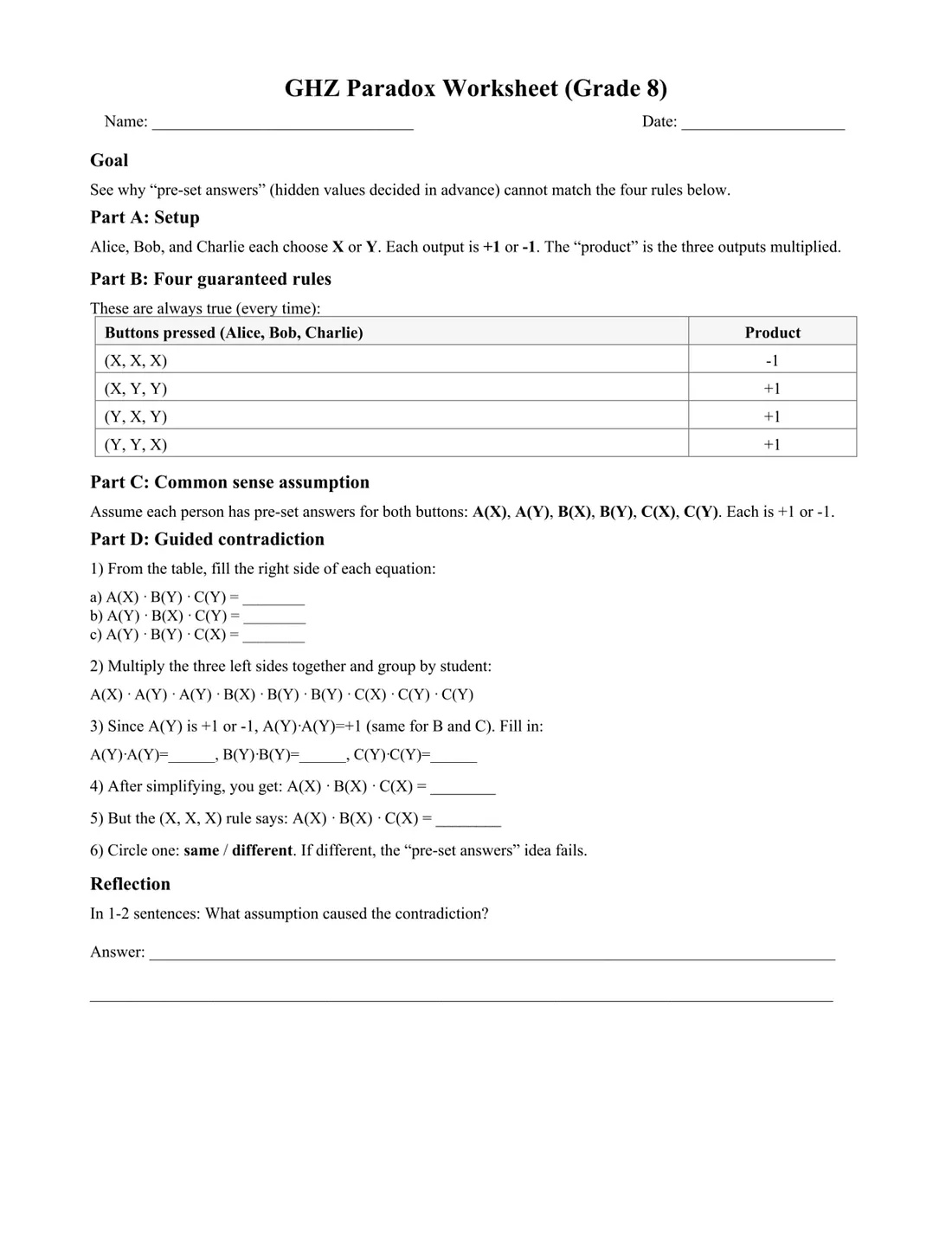
Imagine three friends: Alice, Bob, and Charlie. Each has a magic box. The boxes were built together in a special “quantum” way, so the three boxes are linked even if the friends are far apart.
Each friend can choose one of two buttons to press:
- Button X
- Button Y
When someone presses a button, their box flashes either:
- +1 (think “green”)
- −1 (think “red”)
The weird part is not the individual flashes. The weird part is the pattern across all three boxes.
The GHZ setup (the rule the boxes always follow)
The boxes are linked so that these four “team rules” are always true:
- If Alice presses X, Bob presses X, Charlie presses X then the product of their three results is −1.
- If Alice presses X, Bob presses Y, Charlie presses Y then the product is +1.
- If Alice presses Y, Bob presses X, Charlie presses Y then the product is +1.
- If Alice presses Y, Bob presses Y, Charlie presses X then the product is +1.
“Product” just means multiply the three results. Example: (+1)·(−1)·(−1) = +1.
So the boxes are guaranteed to obey those four multiplication rules every time.
What “common sense” would try to say
A very normal idea is:
Each box already “knows” what it would answer for X and what it would answer for Y, before anyone presses anything.
So for each person we imagine two pre-set answers:
- Alice has A(X) and A(Y)
- Bob has B(X) and B(Y)
- Charlie has C(X) and C(Y)
Each of these is either +1 or −1.
This is the “no magic messaging” + “pre-set answers” idea.
The trap (where common sense breaks)
Look at rules 2, 3, and 4:
2. A(X) · B(Y) · C(Y) = +1
3. A(Y) · B(X) · C(Y) = +1
4. A(Y) · B(Y) · C(X) = +1
Now multiply the left sides of (2)(3)(4) together:
Left side becomes: A(X) · B(Y) · C(Y) · A(Y) · B(X) · C(Y) · A(Y) · B(Y) · C(X)
Group them by person:
- For Alice: A(X) · A(Y) · A(Y)
- For Bob: B(X) · B(Y) · B(Y)
- For Charlie: C(X) · C(Y) · C(Y)
Now use a simple fact:
- Since A(Y) is either +1 or −1, then A(Y)·A(Y) = (+1) always (because (−1)·(−1)=+1, and (+1)·(+1)=+1)
So A(Y)·A(Y)=1, same for B(Y)·B(Y) and C(Y)·C(Y).
That means the whole multiplied left side simplifies to:
A(X) · B(X) · C(X)
So multiplying rules (2)(3)(4) forces:
A(X) · B(X) · C(X) = +1
Because the right sides were +1·+1·+1 = +1.
But rule 1 says:
A(X) · B(X) · C(X) = −1
Both can’t be true.
So the “pre-set answers” idea crashes into a contradiction.
What the GHZ paradox is saying
- If you believe each box carries hidden, pre-written answers for X and Y…
- and you believe the boxes don’t send signals to each other faster than light…
- then the four rules above are impossible to satisfy.
But quantum physics says those four rules can be satisfied (and experiments agree).
So GHZ is a “no excuses” proof that nature can’t work like: “everything already had a definite value and we’re just revealing it.”
It’s not just “quantum is weird.” It’s: common-sense hidden answers cannot explain what really happens.
A simple analogy (not perfect, but helpful)
Think of it like three synchronized dice that don’t decide their numbers until you choose which kind of roll you want (X-roll or Y-roll). And the “team multiplication rule” always comes out right. If you try to pretend each die had both answers written in advance, you get stuck: the math forces two opposite outcomes at the same time.
More in quantum-computing
Cubed
Write about the technologies shaping the future.
For developers, founders, and curious minds exploring AI, crypto, Web3, and emerging tech—signal over noise.
One free account across In Plain English, Stackademic, Venture, and Cubed.
How it works- AI, crypto & Web3
- Software & emerging technologies
- Analysis & practical resources
- Thoughtful voices, not hype
Sign in
Google or GitHub
Complete profile
Takes a few minutes
Get approved & publish
Start sharing
Why write for Cubed?
The future deserves thoughtful voices, not just louder headlines.
Frequently Asked Questions
Common questions about this topic
What is the basic GHZ setup described?
Three friends (Alice, Bob, Charlie) each have a linked box that flashes either +1 or −1 when they press one of two buttons labeled X or Y; the boxes are built in a special quantum-linked way so their joint outcomes always obey specific multiplication rules.
What are the possible inputs and outputs for each box?
Each person can press one of two buttons, X or Y, and each box outputs either +1 (green) or −1 (red).
What does 'product' mean in the GHZ rules?
Product means multiply the three results from Alice, Bob, and Charlie; for example, (+1)·(−1)·(−1) = +1.
What are the four team multiplication rules the boxes always follow?
1) X,X,X gives product −1; 2) X,Y,Y gives product +1; 3) Y,X,Y gives product +1; 4) Y,Y,X gives product +1.
What is the 'pre-set answers' or 'hidden answers' idea?
The pre-set answers idea assumes each box already has definite answers for X and Y before any button is pressed, denoted A(X), A(Y) for Alice, B(X), B(Y) for Bob, and C(X), C(Y) for Charlie, each equal to +1 or −1.
How does multiplying rules 2, 3, and 4 lead to a contradiction with rule 1?
Multiplying the left sides of rules 2, 3, and 4 yields A(X)·B(X)·C(X) after canceling squared terms like A(Y)·A(Y)=+1; the right sides multiply to +1, so those three rules force A(X)·B(X)·C(X)=+1, which directly contradicts rule 1 that requires A(X)·B(X)·C(X)=−1.
What assumption causes the contradiction in the GHZ scenario?
The contradiction arises from the assumption that each box has definite pre-written answers for both X and Y (hidden variables) together with the usual idea that boxes do not signal to each other faster than light.
What does the GHZ paradox conclude about the idea that everything already had definite values?
The GHZ paradox concludes that the view 'everything already had a definite value and we are merely revealing it' cannot account for the four multiplication rules that the linked boxes can satisfy.
Does quantum physics allow the four GHZ rules to be satisfied?
Quantum physics says the four GHZ rules can be satisfied, and experiments agree that such correlations occur.
What simple analogy helps illustrate the GHZ paradox?
A helpful analogy is three synchronized dice that do not decide their numbers until you choose X-roll or Y-roll, and their team multiplication rule always comes out right; pretending each die had both answers written in advance forces a mathematical contradiction.

Comments
Loading comments…