The Internet Has Lost Context: We Need a Verification Layer
4 min readAlfred Akech
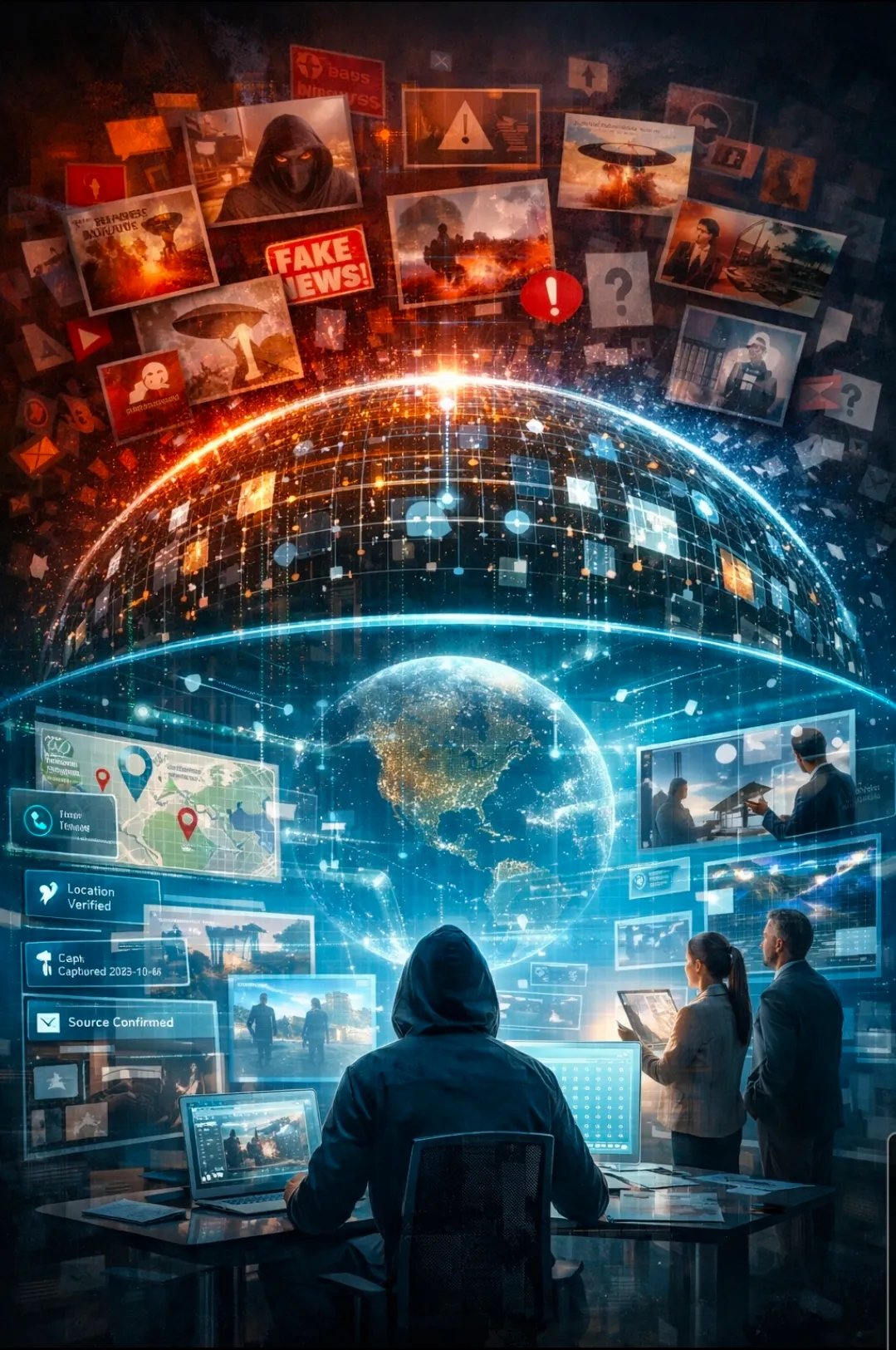
In collaboration with AI
The Missing Context
We often talk about fake news, disinformation, and AI-generated content as if they were temporary problems.
As if better moderation, stricter rules, or more fact-checkers could eventually put the genie back in the bottle.
I don’t think that’s enough.
The problem is not that the world contains lies. It always has.
The real problem is that origin, context, and process have become invisible in an information landscape increasingly produced and amplified by machines.
---
The Internet We Built
The internet was designed for distribution, not for traceability.
A photo, a video, or a text can be copied, cropped, reframed, and reposted endlessly without its origin remaining visible, its timestamp being preserved, or its original context following along.
When AI enters this environment, the question is no longer whether something might be manipulated.
It becomes a deeper problem.
How can we even know what something is?
Was this filmed today or years ago?
Was this written by a human or a model?
Was this generated from scratch or based on real material?
The old internet has no native way to answer these questions.
---
Why Moderation Alone Fails
Most proposed solutions focus on content removal.
Take it down.
Label it.
Ban it.
But this approach does not scale, and it creates new problems.
Centralized power over narratives.
Accusations of censorship.
Underground ecosystems where misinformation thrives unchecked.
More importantly, it treats the symptom, not the cause.
The core issue is not bad content.
It is missing provenance.
---
A Different Approach: A Verification Layer
Instead of replacing the internet, imagine adding a verification layer on top of it.
Not a new web, but an optional, opt-in layer where content can be verified, timestamped, contextualized, and cryptographically anchored.
The old internet continues to exist, chaotic and free.
Alongside it, a second layer emerges, where information carries metadata about how it came to be.
This layer does not decide what is true.
It reveals where things come from.
---
What Verification Actually Means
Verification here is not about declaring truth.
It is about exposing process.
For example:
This video was recorded on this date.
This clip was filmed in this location, with confidence level X.
This image is AI-generated, with no reference material.
This text was produced by a human, edited by AI.
This story originated here, and was later reposted there.
Nothing is hidden.
Nothing is erased.
Context becomes visible again.
---
AI and Humans, Together
The scale of modern information makes human-only verification impossible.
AI would do most of the work.
Analyzing content at scale.
Detecting reuse, manipulation, and synthesis.
Estimating probabilities rather than issuing judgments.
Humans would remain essential.
Reviewing edge cases.
Handling appeals.
Providing journalistic and ethical oversight.
AI provides reach.
Humans provide legitimacy.
---
When AI Acts on Our Behalf
There is another reason this verification layer becomes necessary.
AI is no longer just reading the internet.
It is starting to act on it.
We already see early versions of this.
Asking an AI to send emails for you.
Letting it create websites, posts, or campaigns.
Allowing it to communicate with other systems on your behalf.
As models gain broader access to tools and live systems, the boundary between observer and actor disappears.
At that point, the question is no longer only who created the content.
It is also who authorized the action.
---
Identity, Agency, and Delegation
When a human speaks, we intuitively understand agency.
When an AI speaks for a human, agency becomes ambiguous.
Is this a direct instruction?
An autonomous decision?
A suggested action that was approved?
Without a verifiable layer, these distinctions collapse.
A verification system can make this explicit.
This message was authored by AI.
Acting under delegation from a verified human.
Within defined permissions.
At a specific point in time.
---
AI Personas and Synthetic Actors
As AI becomes more persistent, we will see the rise of AI personas.
Not bots in the old sense.
But long-lived synthetic actors that maintain memory, operate across platforms, and interact continuously with humans and systems.
At scale, these entities will flood the information space.
Trying to ban them is unrealistic.
Pretending they don’t exist is dangerous.
The only viable path is clear identification and provenance.
---
Not a Truth Network, but a Trust Network
This is not about building a ministry of truth.
Truth evolves.
Facts update.
Narratives change.
But provenance, process, and accountability can remain stable.
What we need is not less information.
We need better visibility into how information comes to be.
---
The Real Shift
The future of the internet is not about deciding what is allowed to exist.
It is about restoring context in a world where content is cheap and infinite.
Not replacing chaos.
More in technology

Cubed
Write about the technologies shaping the future.
For developers, founders, and curious minds exploring AI, crypto, Web3, and emerging tech—signal over noise.
One free account across In Plain English, Stackademic, Venture, and Cubed.
How it works- AI, crypto & Web3
- Software & emerging technologies
- Analysis & practical resources
- Thoughtful voices, not hype
Sign in
Google or GitHub
Complete profile
Takes a few minutes
Get approved & publish
Start sharing
Why write for Cubed?
The future deserves thoughtful voices, not just louder headlines.
Comments
Loading comments…