The AI Mindset: Task Automation vs Creative Transformation
6 min readAnkita Deo
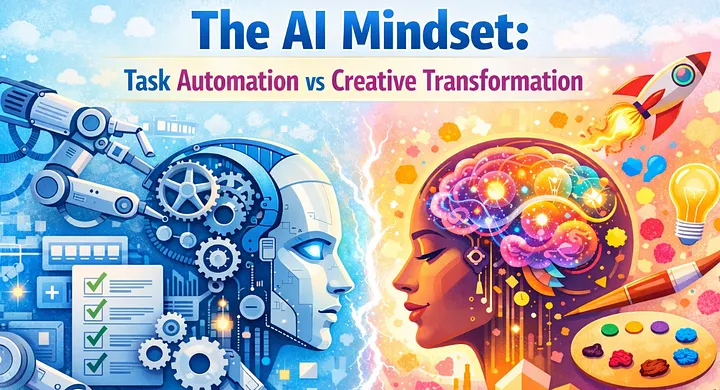
The presence of artificial intelligence has become a worldwide phenomenon. AI tools now function as essential components of daily work tasks, which include email writing and report creation, as well as image production, data analysis, and idea development.
Most people who work as marketers, developers, managers, or students already use some form of AI technology in their daily activities.
The question becomes whether artificial intelligence serves only to automate work processes or whether it creates a new way of thinking and developing content.
Many individuals view artificial intelligence as a useful productivity tool that helps them save time by automating their repetitive tasks. The system performs multiple functions, which include email drafting, meeting summary creation, data processing, and execution of standard operations within seconds.
Automation-based systems have started to create a fundamental transformation that extends beyond their basic functions. AI technology now begins to change how people develop creative work, solve problems, and make decisions.
The current transformation needs what experts refer to as “the AI mindset.” People with an AI mindset use AI technology to eliminate nonproductive tasks, which enables them to work together with machines. The new era requires people to learn how task automation differs from creative transformations.
Understanding Task Automation in the AI Era
Task automation is the most visible and immediate use of AI in organizations. Automation refers to using AI systems to perform repetitive, structured, and rules-based tasks with minimal human involvement.
Examples of AI-driven automation are already common in the workplace:
- Automatically generating reports from data
- Chatbots answering customer queries
- AI scheduling meetings and managing calendars
- Automated document processing and email drafting
These tasks used to consume hours of human effort. With AI, they can often be completed in seconds.
Research suggests that generative AI could significantly boost productivity by handling routine cognitive work like summarizing documents, drafting communications, and analyzing large datasets. This allows professionals to spend less time on repetitive tasks and more time focusing on higher-value activities.
Automation is especially useful for tasks that are:
- Repetitive
- Data-heavy
- Rule-based
- Time-consuming but low in creativity
For example, a financial analyst might use AI to process thousands of transactions quickly, while a customer support team may rely on AI chatbots to answer common questions.
However, automation alone does not define the future of work. If organizations treat AI only as a cost-cutting tool that replaces human effort, they miss its greatest potential.
The Limits of Absolute Automation
Automation provides efficiency benefits through improved processes but creates operational constraints.
AI systems use their trained data patterns to produce output results. AI systems lack human abilities to understand situations, experience life, and feel different emotions. AI-generated results can show incomplete information with built-in biases because the output lacks proper context.
Another challenge is over-reliance on AI. Experts warn that excessive dependence on AI systems will lead to people losing their essential thinking and choice-making abilities, which they would normally develop through active involvement in their responsibilities.
- Automation should help humans to think better, according to this statement.
- The process of creative transformation establishes its significance in this situation.
Moving from Automation to Creative Transformation
The process of shifting control away from automated systems requires complete human artistic control.
The process of creative transformation occurs when artificial intelligence technology transitions from its current operational capacity to a new system that supports human artists through innovative creativity development.
Artificial intelligence systems assist people through their work process because they enable teams to develop concepts and evaluate different options while testing their ideas.
For example:
- Writers use AI to brainstorm article ideas or outlines.
- Designers use AI tools to generate concept visuals.
- Developers rely on AI to suggest code improvements.
- Marketers analyze AI-driven insights to craft better campaigns.
AI technology functions as a creative tool that enables human artists to achieve their full potential through its use.
Studies show that people working with AI often perform better on creative tasks than those working alone because AI can quickly generate ideas and provide alternative perspectives.
The process of work now enters a new phase because people use artificial intelligence systems to enhance their productivity through the AI-augmented workforce model.
The Rise of the AI-Augmented Workforce
Across industries, professionals are increasingly using AI as a co-pilot rather than a replacement.
Writers use AI for ideation. Analysts use it for data interpretation. Designers use it to explore creative directions faster than traditional workflows allow. This collaboration enables people to focus on strategic thinking, storytelling, and problem-solving while AI handles execution-heavy tasks.
Interestingly, research suggests that only a small percentage of jobs are at high risk of full automation. Instead, most roles are expected to experience AI augmentation, where technology supports human capabilities rather than replacing them entirely.
This means the future of work will likely involve humans and AI working together, each contributing unique strengths.
The Real Value of the AI Mindset
People need to change their thinking because they want to adopt AI technology.
People should not ask***“Will AI replace my job?”Instead of asking:“What will AI enable me to accomplish at my work?”***
Professionals who embrace AI as a creative partner discover new opportunities for innovation. AI can create multiple ideas within seconds while it examines current patterns and tests future scenarios, and gives users results that would require several hours to reach.
The system enables humans to dedicate their time to activities that they perform most effectively.
- Human beings need to think strategically
- Human beings need to think creatively
- Human beings need to practice emotional intelligence
- Human beings need to practice ethical judgment
- Human beings need to handle complex decision-making processes
The importance of human abilities stays intact because AI technology only makes them more valuable.
The Skills Needed in the AI Age
As AI becomes more integrated into daily work, certain skills are becoming increasingly important.
Professionals will need to develop abilities that complement AI rather than compete with it.
Key skills for the AI era include:
- AI literacy: Understanding how AI tools work and how to use them effectively
- Critical thinking: Evaluating AI-generated outputs
- Creativity: Generating original ideas and narratives
- Emotional intelligence: Understanding human needs and relationships
- Adaptability: Continuously learning new tools and approaches
The future workforce will not just consist of people who can use AI tools, but those who can guide and collaborate with them.
The Future: From Automation to Transformation
Artificial Intelligence is often framed as a technology that replaces jobs. But the bigger story is how it changes the nature of work itself.
Automation removes repetitive tasks. Transformation expands human potential.
When used correctly, AI allows professionals to spend less time on routine activities and more time on creativity, strategy, and innovation. This shift is already redefining how industries operate and how individuals approach their careers.
The real competitive advantage in the coming years will not simply be access to AI tools; it will be the mindset people bring to using them.
Those who view AI as a threat may struggle to adapt. Those who see it as a collaborator will likely discover entirely new ways to create value.
In the end, the AI revolution is not just about smarter machines. It is about smarter ways of thinking.
More in artificial-intelligence


Cubed
Write about the technologies shaping the future.
For developers, founders, and curious minds exploring AI, crypto, Web3, and emerging tech—signal over noise.
One free account across In Plain English, Stackademic, Venture, and Cubed.
How it works- AI, crypto & Web3
- Software & emerging technologies
- Analysis & practical resources
- Thoughtful voices, not hype
Sign in
Google or GitHub
Complete profile
Takes a few minutes
Get approved & publish
Start sharing
Why write for Cubed?
The future deserves thoughtful voices, not just louder headlines.




Comments
Loading comments…