Minimax Algorithm: From Core Theory to Practical Use in Flutter
4 min readZyad Wael
Artificial intelligence in games is not about making random moves or reacting blindly to the current state. It is about anticipating future decisions and choosing actions that remain strong even under the best possible opposition. One of the earliest and most influential algorithms built around this idea is the Minimax algorithm.
Minimax provides a formal way to reason about decisions in competitive environments. It is widely used in turn-based games, strategic simulations, and adversarial problem solving. In this article, we will first explain Minimax as a general algorithm, then discuss how it can be integrated into a Flutter application in a technology-agnostic way, and finally demonstrate its practical use through a chess example.
1. The Minimax Algorithm
Minimax is a decision-making algorithm designed for two-player, turn-based, zero-sum games. In such games, one player’s success directly results in the other player’s loss. The algorithm assumes that both players act rationally and always choose the optimal move available to them.
The core idea is simple:
- One player aims to maximize the evaluation score.
- The opposing player aims to minimize that same score.
By simulating future moves for both sides, Minimax selects the action that guarantees the best possible outcome in the worst-case scenario.
2. How Minimax Makes Decisions
Minimax explores the game through a tree structure:
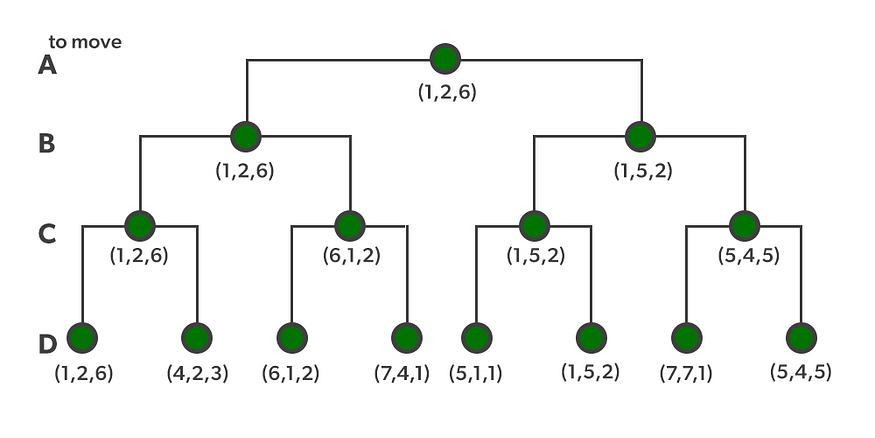
- Each node represents a game state.
- Each branch represents a possible move.
- The depth of the tree represents how many turns ahead the algorithm is allowed to look.
The algorithm works in the following steps:
- Generate all possible moves from the current state.
- Recursively simulate each move.
- Stop the simulation at a terminal state or a predefined depth.
- Evaluate the resulting states using a scoring function.
- Propagate the scores upward:
- Maximizing layers choose the highest score.
- Minimizing layers choose the lowest score.
The value returned to the root determines the optimal decision.
3. Integrating Minimax into a Flutter Application
Minimax itself is independent of any user interface. In a Flutter application, it should be implemented as pure Dart logic, separate from widgets, animations, and user interactions.
To integrate Minimax into any Flutter app, you generally need:
- A representation of the application state
- A way to generate valid next states
- A method to evaluate a state numerically
- A Minimax function that explores state transitions
This approach allows Minimax to be reused across different problem domains without modifying UI code
4. Generic Minimax Implementation in Dart
A simplified Dart implementation of Minimax looks like this:
int minimax(
  GameState state,
  int depth,
  bool isMaximizing,
) {
  if (depth == 0 || state.isTerminal) {
    return state.evaluate();
  }

  final nextStates = state.generateNextStates();

  if (isMaximizing) {
    int bestValue = -100000;
    for (final next in nextStates) {
      final value = minimax(next, depth - 1, false);
      bestValue = bestValue > value ? bestValue : value;
    }
    return bestValue;
  } else {
    int bestValue = 100000;
    for (final next in nextStates) {
      final value = minimax(next, depth - 1, true);
      bestValue = bestValue < value ? bestValue : value;
    }
    return bestValue;
  }
}
This structure applies to any turn-based decision problem, not only games.
5. Applying Minimax in a Chess App
Chess is one of the most natural applications of Minimax. It satisfies all the algorithm’s assumptions: two players, alternating turns, full information, and directly opposing goals.
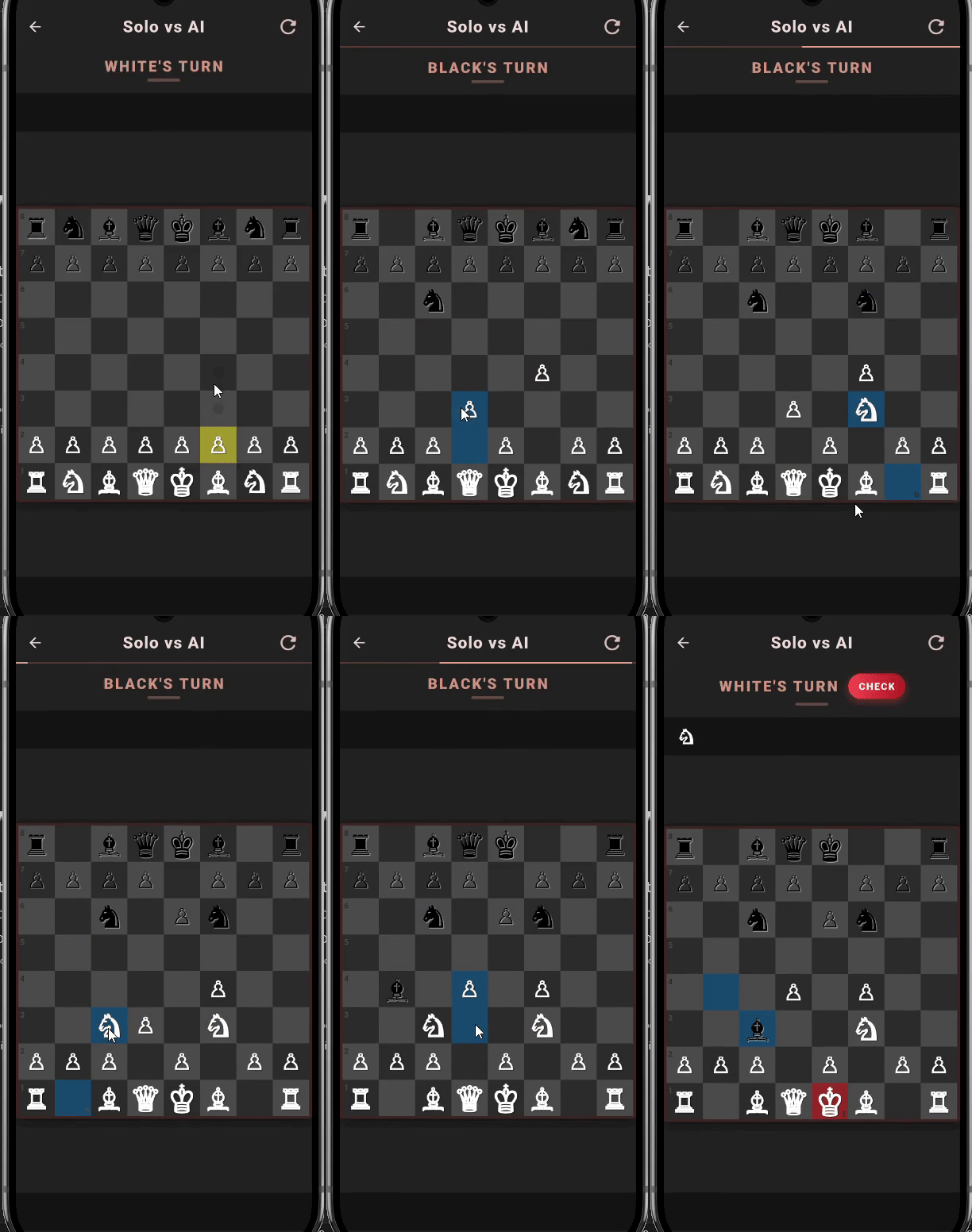
In a chess application:
- A board position represents a game state.
- Legal chess moves generate successor states.
- An evaluation function assigns a numeric score to a position.
When it is the AI’s turn:
- All legal moves are generated.
- Each move is simulated on a copied board.
- Minimax is applied to a fixed depth.
- The move with the best guaranteed evaluation is selected.
Even with limited depth, this approach produces competitive and human-like gameplay
Conclusion
The Minimax algorithm remains a foundational tool for decision-making in adversarial environments. Its strength lies in its ability to model rational opponents and evaluate outcomes beyond the immediate move.
In Flutter applications, Minimax should be implemented as isolated business logic, free from UI concerns and executed efficiently to preserve responsiveness. Once understood, the same algorithm can be applied to a wide range of problems, from simple board games to complex strategic simulations, with chess standing as one of its most classic and effective demonstrations.
🙌 Thanks for Reading!
If you enjoyed this article or found it helpful, feel free to:
More in flutter
Cubed
Write about the technologies shaping the future.
For developers, founders, and curious minds exploring AI, crypto, Web3, and emerging tech—signal over noise.
One free account across In Plain English, Stackademic, Venture, and Cubed.
How it works- AI, crypto & Web3
- Software & emerging technologies
- Analysis & practical resources
- Thoughtful voices, not hype
Sign in
Google or GitHub
Complete profile
Takes a few minutes
Get approved & publish
Start sharing
Why write for Cubed?
The future deserves thoughtful voices, not just louder headlines.


Comments
Loading comments…