Gen AI: Transforming Industries & Workforce Dynamics Amidst Ethical Challenges & Rapid Adoption
The Promise and Perils of AI-Driven Innovation
6 min readAnkita Deo
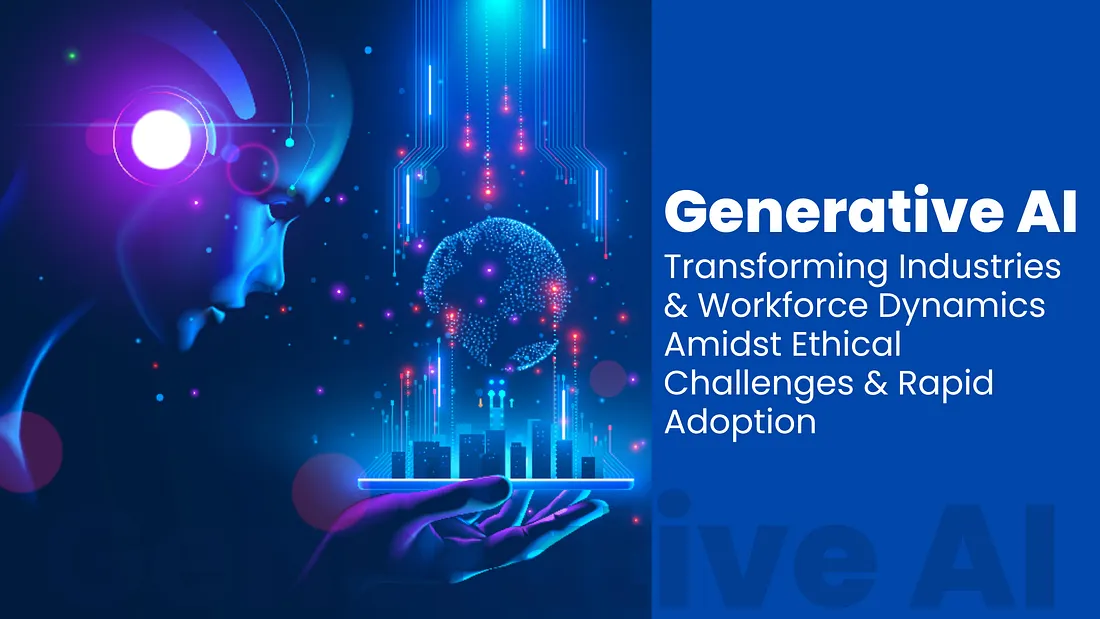
Generative artificial intelligence, or AI, has quickly become a new form of revolutionism that is revolutionizing some industries, changing the nature of work and employment, and modifying the ways people think about creativity and idea generation.
Damaging or misleading this generative technology, which is able to create human-like text, images, and even code, is rapidly gaining popularity in different fields, including scientific research, marketing, and education.
However, as generative AI progresses and becomes a more and more embedded feature in the way in which we work and live, it arrives with various ethical conundrums and issues that deserve close consideration.
Impact on Scientific Research:
The impact of generative AI on scientific research has been particularly significant. Researchers are increasingly leveraging AI tools to assist with coding, data analysis, and survey design, streamlining complex processes and potentially accelerating the pace of discovery.
A guide from the Michigan Institute for Data Science (MIDAS) highlights the importance of validating AI outputs and addressing ethical considerations in research settings.
As AI becomes more prevalent in academic work, the question of properly crediting AI contributions has become a crucial aspect of responsible usage.
Generative AI in the Metaverse:
Beyond the realm of research, generative AI is making waves in the emerging metaverse era.
As digital experiences become more immersive and interconnected, AI-driven content creation is poised to play a pivotal role in shaping these virtual environments.
From generating realistic avatars to crafting entire digital landscapes, generative AI has the potential to disrupt various sectors, including gaming, entertainment, and virtual commerce.
Transforming Education:
The education sector is another area where generative AI is making significant inroads. A recent study examining university students’ perceptions of generative AI technologies revealed both excitement and apprehension.
Students highlighted the benefits of AI in education, such as personalized learning experiences and writing assistance.
However, concerns were also raised regarding the accuracy of AI-generated content, privacy issues, and the broader implications for personal development and future career prospects.
Expanding Applications:
As generative AI continues to advance, its applications are expanding across diverse fields. The MIDAS resource hub showcases a wealth of research papers and models related to generative AI, demonstrating its potential in areas such as art, music, and healthcare.
This rapid proliferation of AI-driven solutions is not only changing how we approach creative and analytical tasks but also raising important questions about the future of work and human creativity.
Challenges in Consumer Trust:
One of the most pressing challenges facing the widespread adoption of generative AI is the issue of consumer trust.
A study in the marketing sector found that explicitly mentioning AI involvement in product or service creation can actually reduce consumer trust.
This finding underscores the complex relationship between technological advancement and human perception, highlighting the need for transparent and ethical deployment of AI technologies in consumer-facing applications.
Ethical Implications:
The ethical implications of generative AI extend far beyond consumer trust. As AI systems become more sophisticated in generating human-like content, concerns about misinformation, deep fakes, and the potential for malicious use of these technologies have come to the forefront.
Striking a balance between innovation and responsible use of AI has become a critical challenge for policymakers, industry leaders, and researchers alike.
Workforce Transformation:
In the workplace, generative AI is reshaping traditional roles and skill requirements. While AI tools can enhance productivity and streamline processes, they also raise questions about job displacement and the evolving nature of human expertise.
As AI systems become more capable of performing tasks that were once exclusively human domains, workers across industries are faced with the need to adapt and develop new skills that complement, rather than compete with, AI capabilities.
Addressing Bias and Fairness:
The rapid adoption of generative AI is also bringing to light issues of bias and fairness in AI systems.
As these technologies are trained on vast datasets of human-generated content, they can inadvertently perpetuate and amplify existing societal biases.
Ensuring that AI systems are developed and deployed in a way that promotes equity and inclusivity has become a critical challenge for the AI community.
Potential Benefits:
Despite these challenges, the potential benefits of generative AI are immense. In healthcare, AI-driven tools are assisting in drug discovery, personalized treatment plans, and early disease detection.
In the creative industries, AI is opening up new avenues for expression and collaboration between human artists and machine intelligence. The key lies in harnessing these capabilities while mitigating potential risks and negative impacts.
The Path Forward:
As we navigate this new era of AI-driven innovation, collaboration between technologists, ethicists, policymakers, and the public will be crucial.
Developing frameworks for responsible AI development and use, investing in AI literacy across society, and fostering ongoing dialogue about the implications of these technologies will be essential steps in ensuring that generative AI serves the greater good.
Conclusion:
Finally, I would like to stress that generative AI occupies a standpoint of the technological breakthrough that is remaking the world as we know it.
One cannot deny the fact that how it is enhancing human creativity, speeding up the advancements in science and technology, and reshaping the business world. But as we adapt and assimilate such progress, it is important to also look at the moral issues and social repercussions that go along with them.
If the growth and deployment of generative AI is to proceed in the right way and for the right purposes, it is necessary to keep improved standards of openness to scientific and technological progress in balance with the need to address the proper governance, risks, and equipped with a vision of generative AI systems for positive social benefit at an individual and collective level.
In the further development of generative AI as part of the next generation of AI, it will surely become even more central to the future. The road that stretches before us is promising and dangerous at the same time, and it is up to us to ensure that this potent technology will contribute to the creation of values that will benefit mankind.
This brings us to the one unarguable fact — AI is generative; the world we live in is in the process of being transformed by it comprehensively and incessantly. However, the crucial question is whether this innovation is positive and is heading in the right direction, or is, in fact, negative and dangerous to humanity and our values.
Thank you for reading!
More in generative-ai

Cubed
Write about the technologies shaping the future.
For developers, founders, and curious minds exploring AI, crypto, Web3, and emerging tech—signal over noise.
One free account across In Plain English, Stackademic, Venture, and Cubed.
How it works- AI, crypto & Web3
- Software & emerging technologies
- Analysis & practical resources
- Thoughtful voices, not hype
Sign in
Google or GitHub
Complete profile
Takes a few minutes
Get approved & publish
Start sharing
Why write for Cubed?
The future deserves thoughtful voices, not just louder headlines.
Frequently Asked Questions
Common questions about this topic
What is generative AI?
Generative AI is technology that creates human-like text, images, and code and is rapidly being adopted across industries.
How is generative AI impacting scientific research?
Generative AI assists researchers with coding, data analysis, and survey design, streamlining processes and potentially accelerating discovery while raising the need to validate outputs and address ethical considerations and proper crediting.
What role does generative AI play in the metaverse?
Generative AI can create realistic avatars and entire digital landscapes, shaping immersive and interconnected virtual environments and affecting gaming, entertainment, and virtual commerce.
How is generative AI transforming education?
Generative AI offers personalized learning and writing assistance that students find beneficial, while also raising concerns about accuracy, privacy, personal development, and future career implications.
In which fields are generative AI applications expanding?
Generative AI applications are expanding across art, music, healthcare, scientific research, marketing, and education, among other areas.
What challenge does consumer trust present for generative AI adoption?
Consumer trust is challenged because explicitly mentioning AI involvement in creating products or services can reduce trust, illustrating a complex relationship between technology and human perception.
What are the main ethical concerns associated with generative AI?
Main ethical concerns include misinformation, deep fakes, malicious use, transparency, governance, and balancing innovation with responsible deployment.
How is generative AI affecting the workforce?
Generative AI is reshaping roles and skill requirements by enhancing productivity and automating tasks, which raises questions about job displacement and the need for workers to develop skills that complement AI.
What issues of bias and fairness arise with generative AI?
Generative AI systems trained on large human-generated datasets can perpetuate and amplify existing societal biases, creating a critical challenge to promote equity and inclusivity.
What potential benefits does generative AI offer?
Generative AI offers benefits such as aiding drug discovery, enabling personalized treatment plans and early disease detection in healthcare, and creating new avenues for expression and collaboration in the creative industries.
What actions are needed to ensure responsible development and use of generative AI?
Responsible development requires collaboration among technologists, ethicists, policymakers, and the public, developing frameworks for responsible use, investing in AI literacy, and fostering ongoing dialogue about implications.
What is the overall assessment of generative AI's future impact?
Generative AI is transforming the world comprehensively and incessantly, offering promising benefits while posing moral, social, and governance risks that must be addressed to ensure positive outcomes for humanity.
Comments
Loading comments…