Envisioning Tomorrow: The Transformative Impact of Generative AI
How Generative AI is Reshaping Industries, Driving Economic Growth, and Redefining Innovation
4 min readAnkita Deo
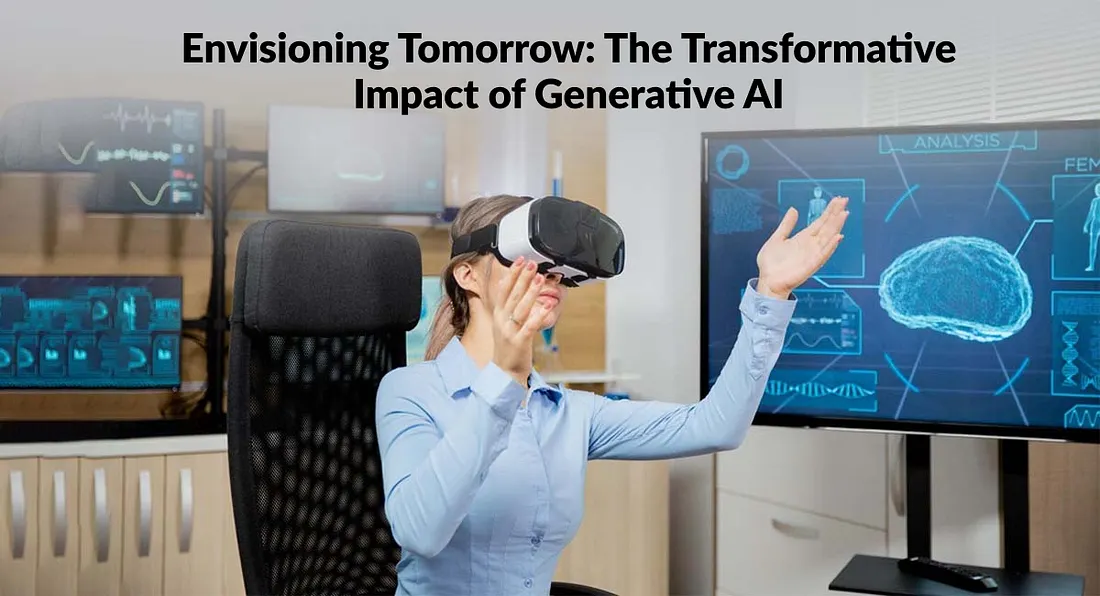
Generative AI appears to be right in the middle of a tech revolution, causing ripples in industries, improving productivity, and transforming economies.
From creating content to enhancing the efficiency of software development, generative AI happens to become an engine of rapid advancement and marks itself as the driving force behind digital transformation.
The article will give an in-depth perspective on how generative AI has shaped market growth, transformation per industry, cost savings, future trends, insights drawn from the best research, and projections by various experts.
Market Growth and Economic Impact
The rapid adoption of generative AI is leading to unprecedented market expansion and economic contributions.
- Generative AI Market Size: The global generative AI market is projected to grow to $220 billion by 2025, showcasing the surging demand for AI-powered solutions across industries (Spritle, 2025).
- Global AI Market Value: The broader AI market is expected to reach $1.2 trillion by 2025, growing at a CAGR of 26%, reflecting the increasing integration of AI into various business functions (Spritle, 2025).
- Economic Contribution: Generative AI is estimated to contribute between $2.6 trillion and $4.4 trillion annually to global GDP, reinforcing its role in driving efficiency and productivity (McKinsey, 2025).
These figures highlight the pivotal role of AI in shaping global economies, as businesses continue to invest in AI-driven solutions to gain a competitive edge.
Industry-Specific Transformations
Generative AI is revolutionizing several industries by improving efficiency, automating tasks, and creating new opportunities.
1. Content Creation
By 2025, generative AI is expected to produce 50% of all digital content, including marketing materials, advertisements, and social media posts (Spritle, 2025). AI-powered content creation tools enable businesses to scale their marketing efforts, enhance personalization, and optimize content strategies.
2. Software Development
Generative AI is projected to handle 40% of all programming tasks by 2025, significantly reducing software development time and lowering error rates by 40% (McKinsey, 2025). AI-driven coding assistants help developers write cleaner, more efficient code while improving security measures.
3. Customer Operations & Engagement
AI-powered chatbots and virtual assistants are expected to be integrated into 75% of enterprise customer service operations by 2025, enhancing response times and personalizing user experiences (PwC, 2025).
This transformation reduces operational costs while improving customer satisfaction.
These industry-specific shifts demonstrate AI’s ability to streamline processes and unlock new revenue streams across diverse sectors.
Efficiency and Cost Savings
As businesses strive to optimize operations, generative AI is becoming a key tool in driving efficiency and reducing costs.
- Content Production Cost Reduction: Companies leveraging AI for content generation can cut production costs by 30%, while 25% of social media content is expected to be automated (Spritle, 2025).
- Time Savings in R&D: In pharmaceuticals, generative AI is set to accelerate drug discovery processes, potentially saving billions by reducing research timelines that traditionally span over a decade (McKinsey, 2025).
These cost savings highlight AI’s potential in improving operational efficiency and delivering higher returns on investment.
Future Trends: What Lies Ahead?
As generative AI continues to evolve, several key trends will shape its trajectory in the coming years.
1. Democratization of AI Tools
With open-source AI models becoming more accessible, small and mid-sized businesses will gain access to high-quality AI tools, fostering innovation across industries (DataForest, 2025).
2. Human-Level Performance
By the end of the decade, AI is expected to perform at levels comparable to top human professionals in specialized technical tasks, enhancing decision-making across various sectors (DataForest, 2025).
These advancements indicate that generative AI will not only transform business landscapes but also redefine human-AI collaboration, leading to unprecedented efficiency and creativity.
Conclusion
Safety of labor while they rejoice in the celebration of Christmas. Ever since the last few weeks, after every Christmas, something strange has been happening with the people.
From month-end until the very eve of the holiday, the country explodes into a week of uninterrupted partying.
Generative AI-the product of futuristic thinking finally arrived today and is encroaching on most industries, optimizing almost all processes, and enhancing economic growth.
These activities are in sight of a projected market value of up to $220 Billion by 2025 and involve specific areas like content creation, software development, customer operations, and further horizons.
Organizations that choose to adopt AI in their operations should outline an agenda for responsible AI development, upskilling employees for such initiatives, and pertinent ethical implementation of AI for sustainability. This technology will shape the future of most people. Use it wisely today.
Are you ready to grab the transforming effect of AI for future generations? Welcome to this revolution driven by artificial intelligence!
More in artificial-intelligence


Cubed
Write about the technologies shaping the future.
For developers, founders, and curious minds exploring AI, crypto, Web3, and emerging tech—signal over noise.
One free account across In Plain English, Stackademic, Venture, and Cubed.
How it works- AI, crypto & Web3
- Software & emerging technologies
- Analysis & practical resources
- Thoughtful voices, not hype
Sign in
Google or GitHub
Complete profile
Takes a few minutes
Get approved & publish
Start sharing
Why write for Cubed?
The future deserves thoughtful voices, not just louder headlines.
Comments
Loading comments…