Deep Learning Basics That Make You AI-Ready Fast
See how machines actually learn
5 min readNagaraj
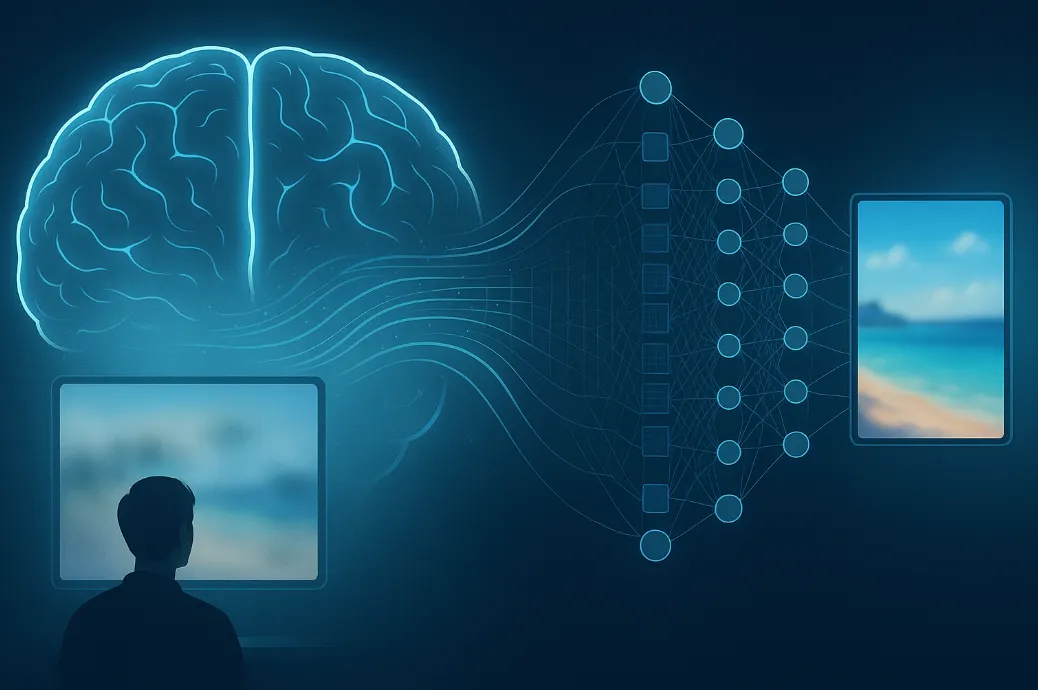
Saw an AI output and experienced simultaneous emotions of awe… and doubt?
That was indeed my case. Focusing on an AI-created picture that was almost right. Almost.

AI Image
To the casual observer, all was at ease. It was a sunny day. There were people on the beach. A big sandcastle was in the center.
But then there was something that didn’t feel quite right.
So, I magnified the picture. The faces were completely nonsensical. Minor details were not right but I couldn’t point out how exactly.
And that moment, that very displeasure, was when I got the idea of deep learning.
Because that is the precise way how deep learning operates.
Deep Learning Begins With Perception 🧠
Your brain is not capable of comprehending everything simultaneously.
It explores. It feels. It clarifies.
That picture of the beach demonstrated it.
Initially, I just took in the surroundings. Then the things. Then the minute particulars. Ultimately, the errors.
Deep learning adopts a similar pace.
- The first inputs are indistinct and unprocessed
- The recognition of patterns proceeds slowly
- The clarity of meaning increases one layer at a time
This is not a miracle. It is a process of understanding in stages.
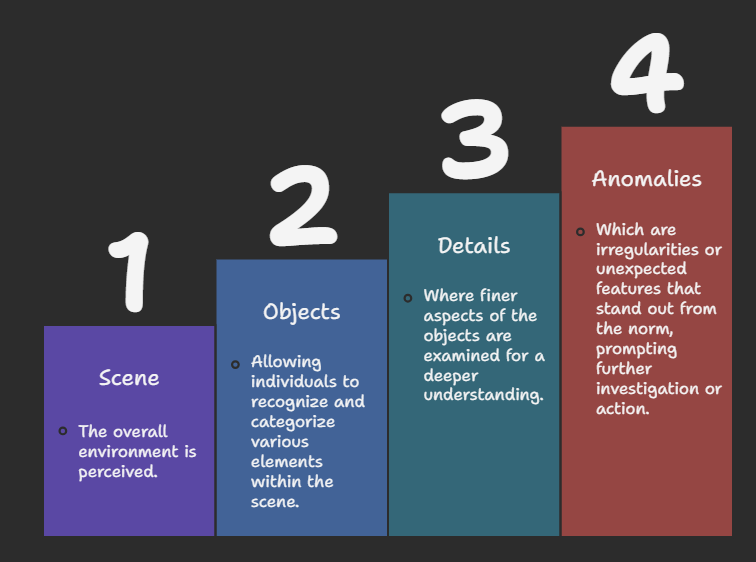
Instantaneous understanding does not occur — rather, it is multilayered.
Neural Networks Process Layer by Layer 🧩
Panic sets in when people look at neural network diagrams.
Circles are a lot. Lines are a lot. Math is a lot.
Don’t let the noise distract you.
A neural network is nothing more than the flow of information through layers, with each layer contributing to the clarity of the signal.
- The input layer sees the raw data
- The hidden layers extract the features
- The output layer makes the decision
The same way your brain did with that picture.
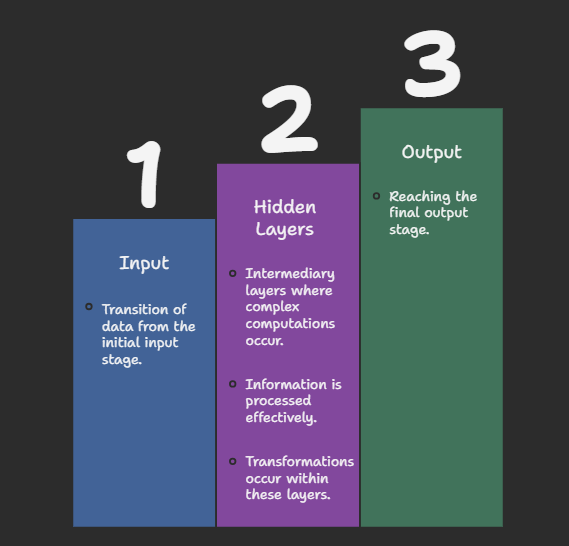
So, clarity is something that is built and not received.
Inside an Artificial Neural Network (ANN) 🔗
ANNs are biological motivated but they don’t have human mind.
They do calculations. Non-stop.
neurons (nodes) are present in every layer and they:
- Get inputs
- Do the multiplication with weights
- Perform non-linear function
- Send the output to next layer
With more layers, comes more abstract.
- Basic networks reveal just simple patterns
- Advanced networks merge patterns meaningfully
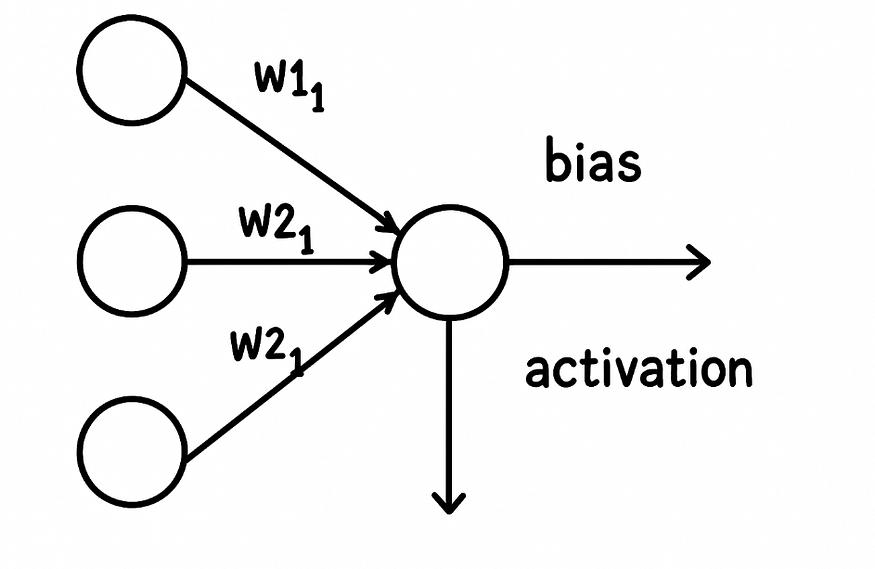
Graphs of weights, activations, and bias for ANN
Every layer helps to convert noise into information.
How Images Become Numbers 🖼️➡️🔢
The neural network part is the one that shattered my mental model.
Never ever-images are seen by the neural networks.
Only numbers are seen.
Consider the MNIST digit data set.
Every image has a resolution of 28 × 28 pixels.
It transforms into:
- 784 input nodes
- The value held by each node
- Brightness is represented by the value
White → 0 Darker → higher number
Thus, nothing more.
No secret. Merely mathematics.
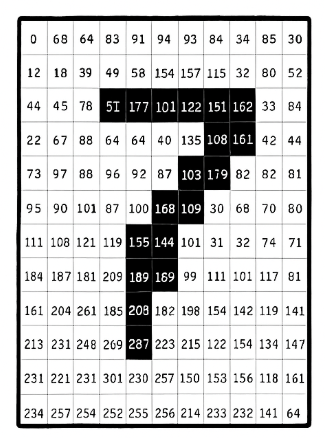
AI, in other words, doesn’t observe images but rather recognizes mathematical patterns in them.
Depth Changes Everything 🏗️
The question arises, why not to limit it to one layer only?
The reason is that comprehension is a hierarchic process.
Let’s take digit 3 for illustration:
- The first layer recognizes the edges and curves
- The second layer fuses the curves into loops
- The third layer sees the whole digit shape
Presenting a more precise question is the role of each layer.
- Is there an edge present?
- Is there a curve present?
- Are these curves forming a number?
Abstraction is the result of depth.
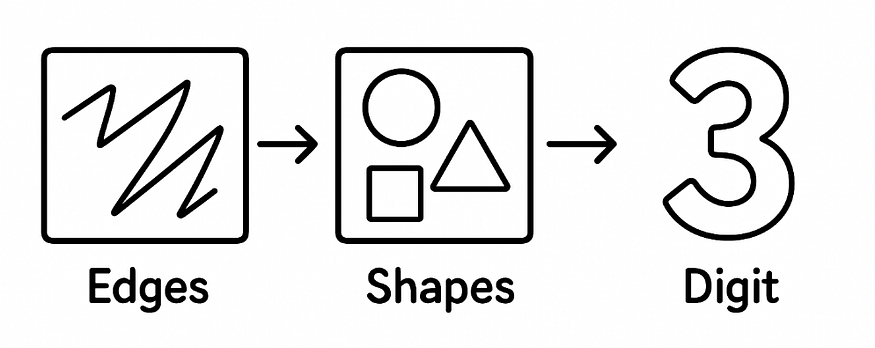
Feature-by-feature extraction
The sophisticated thoughts are nothing but the simple ones ordered properly and thus difficult to understand.
AI demo of neural networks application 💻
Let’s establish the case.
The simplest neural network with Keras and Python.
from tensorflow.keras.models import Sequential
from tensorflow.keras.layers import Dense, Flatten
from tensorflow.keras.datasets import mnist

# Load data
(x_train, y_train), (x_test, y_test) = mnist.load_data()

# Normalize
x_train = x_train / 255.0
x_test = x_test / 255.0

# Build model
model = Sequential([
    Flatten(input_shape=(28, 28)),
    Dense(128, activation='relu'),
    Dense(64, activation='relu'),
    Dense(10, activation='softmax')
])

# Compile
model.compile(
    optimizer='adam',
    loss='sparse_categorical_crossentropy',
    metrics=['accuracy']
)

# Train
model.fit(x_train, y_train, epochs=5)

# Evaluate
model.evaluate(x_test, y_test)
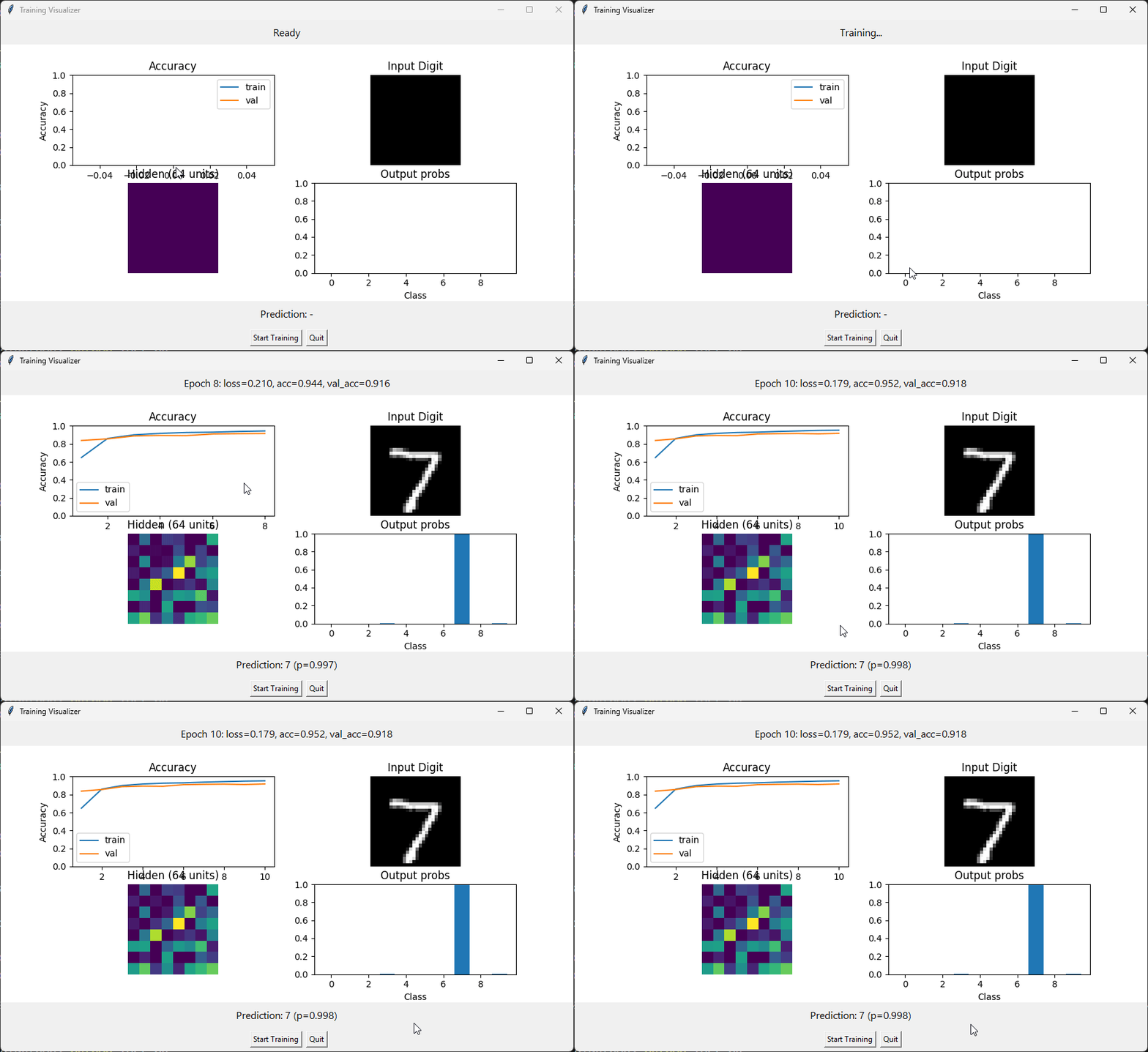
Here’s what is going on:
- Flatten changes the representation from pixels to numbers, and
- Hidden layers discover characteristics,
- Final layer estimates the digit.
Weight adjustments are made with each epoch, Each round contributes to the comprehension.
The learning process is trading of repetition and feedback.
How Learning Actually Happens 🔄
Neural networks cannot tell when they are correct or not.
They conduct a guess. They compute error. They alter.
This loop goes on again and again for thousands of times:
- Prediction made
- Error calculated
- Weights adjusted
- Prediction gets better
That is learning.
Neither awareness nor intuition is involved, only optimization.
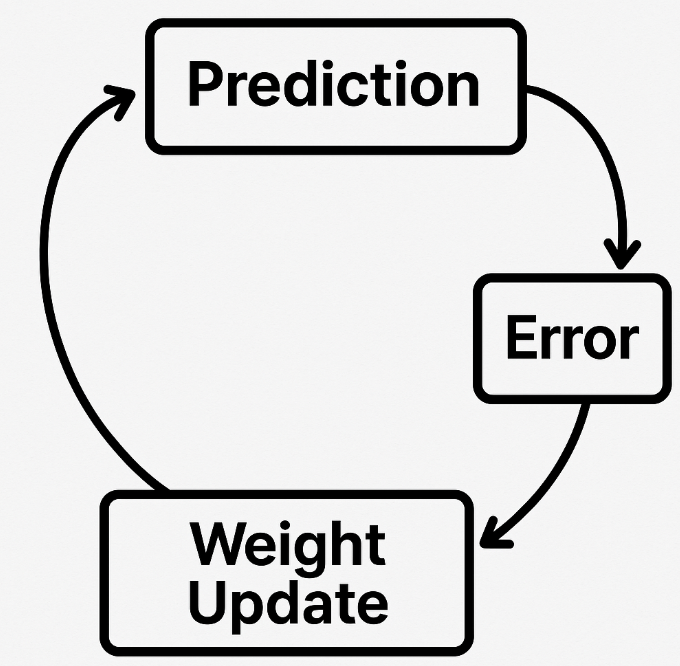
Intelligence comes out of rectification.
Why Deep Learning Changed Everything 🚀
The systems which were in use before relied heavily on the humans for defining rules.
Deep learning is the process where rules are derived from the data.
A change in the way of thinking released the following:
- Image recognition
- Speech processing
- Language models
- Generative AI
The depth of the technology made machines think like humans very efficiently.
Not aware. Not original. But super accurate.
Deep learning technology was not an imitation of intelligence but rather a massive increase in pattern recognition.
In case you have ever experienced the feeling of drowning in AI diagrams, then, you are not alone. The only thing was that you were not equipped with a mental model.
When you perceive deep learning as your brain thinks it already works… it is no more fearsome.
It is, instead, a plain conclusion.
Thank you for reading!
More in deep-learning

Cubed
Write about the technologies shaping the future.
For developers, founders, and curious minds exploring AI, crypto, Web3, and emerging tech—signal over noise.
One free account across In Plain English, Stackademic, Venture, and Cubed.
How it works- AI, crypto & Web3
- Software & emerging technologies
- Analysis & practical resources
- Thoughtful voices, not hype
Sign in
Google or GitHub
Complete profile
Takes a few minutes
Get approved & publish
Start sharing
Why write for Cubed?
The future deserves thoughtful voices, not just louder headlines.
Comments
Loading comments…