Beyond the Model: The Evolving Architecture of Enterprise AI Agents
7 min readDrraghavendra
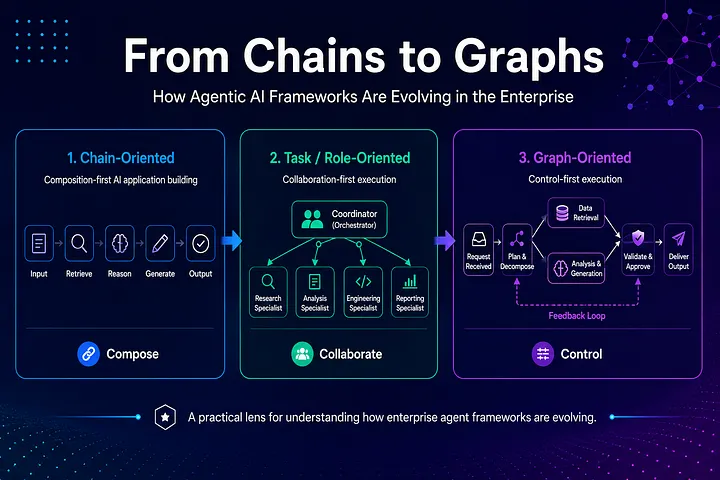
Introduction :
Enterprise AI conversations often start with model comparisons — evaluating which system reasons more effectively, processes complex documents faster, or executes tool calls with greater reliability. These benchmarks are useful during initial assessment, but their importance fades once AI systems are deployed within real-world enterprise workflows. At that point, the emphasis shifts from raw capability to governance and control. The question is no longer simply whether an AI can produce the right answer, but whether it should be authorized to take action. As AI evolves from an advisory role to an operational one, the core architectural challenge becomes not intelligence, but oversight.
When an AI transitions from advising to executing, the central architectural question becomes:
“Should this agent be allowed to call this tool, with these arguments, in this business context, without approval?”
Because the AI industry currently lacks a standardized taxonomy, navigating this shift requires a practical framework. We can classify modern agentic tools into three distinct architectural lenses based on the type of execution they support: Chain-Oriented Frameworks, Role/Task-Oriented Frameworks, and Graph-Oriented Runtimes.
1. Chain-Oriented Frameworks: Composition & Rapid Development
Workflow and Orchestration of Chain Oriented frameworks depicted as follows:
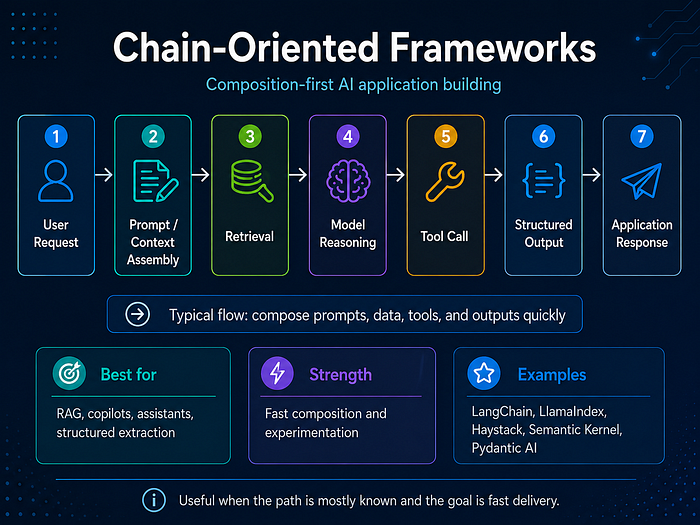
Chain-oriented frameworks are built for speed and integration. They excel at connecting disparate components — prompts, models, retrievers, vector databases, and basic tool outputs — to accelerate the transition from a raw model call to a functional application.
While not an official product category, this lens represents a composition-first approach to building AI. Several prominent frameworks fit into this paradigm, each offering distinct advantages for enterprise teams:
- LangChain: Ideal for composing LLM application components, prompt templates, basic retrieval pipelines, and early-stage agent patterns.
- LlamaIndex: Highly optimized for document ingestion, data indexing, context engineering, and retrieval-augmented generation (RAG).
- Haystack: Well-suited for designing modular search pipelines, document routing, semantic ranking, and generator-based workflows.
- Semantic Kernel: A robust choice for integrating AI directly into established enterprise application code, plugins, and traditional software engineering practices.
- Pydantic AI: Focuses on type safety, strict data validation, and clean application boundaries within Python environments.
Why the Composition-First Approach Matters
For many enterprise teams, a chain-oriented approach is the logical starting point. It allows developers to experiment quickly, proving whether a model can understand a specific task, retrieve the correct internal context, and provide structured outputs.
This approach is highly effective for low-risk, advisory applications such as internal knowledge assistants, document summarizers, reporting copilots, or structured data extraction pipelines. However, rapid composition does not inherently guarantee safe execution within a broader business process.
2. Role and Task-Oriented Frameworks: Agentic Collaboration
As AI applications evolve past single-prompt interactions, enterprise workflows often demand collaborative problem-solving. This is where role- and task-oriented frameworks become relevant.
Instead of relying on a single, over-burdened agent, these frameworks encourage developers to model AI systems after human organizational structures. Tasks are divided among specialized agents with distinct responsibilities:
- CrewAI: Focuses on role-based task execution, enabling structured collaboration and predictable handoffs between agents.
- AutoGen: Optimizes for multi-agent conversations, complex multi-party interactions, and experimental agent environments.
- OpenAI Agents SDK: Streamlines delegation and explicit handoffs between highly specialized, narrow-scope agents.
In a typical enterprise knowledge workflow, this looks like a digital assembly line: a Researcher Agent gathers unstructured data, an Analyst Agent evaluates the findings against policy, a Compliance Agent flags potential risks, and a Writer Agent generates the final report.
The Governance Gap in Multi-Agent Systems
While role-oriented frameworks mimic human productivity, they do not automatically solve the problem of enterprise governance. A cluster of autonomous agents can still behave unpredictably if explicit boundaries are missing. Without rigorous architecture, teams are left with critical vulnerabilities: Which agent is allowed to access sensitive customer data? When can an agentic draft cross the boundary to become an outbound email?
Answering these questions requires looking beyond agent design and focusing on execution runtimes.
3. Graph-Oriented Runtimes: Deterministic Control & Stateful Workflows
The third lens shifts the mental model entirely. While a chain-focused framework asks what components to connect, and a role-focused framework asks who should do the work, a graph-oriented runtime defines which execution paths are permitted.
Frameworks like LangGraph or Google ADK workflow patterns treat AI execution as a directed graph. Teams explicitly define nodes (actions like calling a model, fetching data, or validating permissions) and edges (the conditional paths, loops, and state transitions between those actions).
Transitioning from Prompts to Governed Workflows
Real-world business processes are rarely linear. They require error handling, retries, escalations, explicit state management, and human-in-the-loop approvals. A graph-oriented runtime provides the deterministic guardrails necessary to handle this complexity safely.
Consider an automated procurement agent. If the AI confidently decides to order $50,000 worth of equipment from a supplier, a mature enterprise architecture cannot rely solely on the model’s internal reasoning. The system must utilize a graph-oriented runtime to enforce business logic:
[Agent Proposes Order] ──> [Check Budget Limit] ──> Exceeds $10,000?
                                  │
                       ┌──────────┴──────────┐
                       ▼ YES                 ▼ NO
             [Pause for Human Approval]    [Execute API Call]
                       │                     │
                       └──────────┬──────────┘
                                  ▼
                        [Log to Audit Trail]
By making the state explicit and inserting hard boundaries, graph runtimes separate pure reasoning from operational routing. If a tool call fails, the system knows whether to retry, escalate to a human operator, or halt execution entirely.
Balancing Productivity and Control
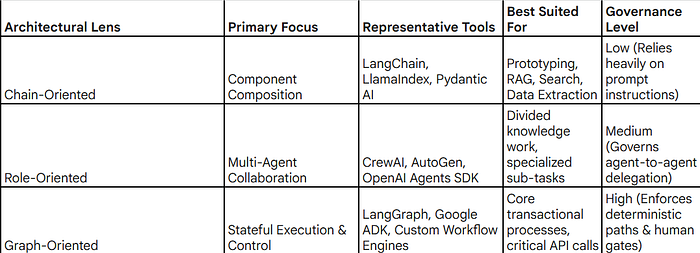
Mature enterprise architectures rarely rely on a single framework. Instead, they layer these paradigms to balance developer velocity with systemic safety.
Comparison Table represented as follows:
The Ultimate Enterprise Real-World Test
To determine if an AI architecture is enterprise-ready, teams must deconstruct the core implementation question phrase by phrase:
- “Should this Agent…” defines identity, security clearance, and organizational role.
- “…be allowed to call this Tool…” establishes strict operational boundaries and API permissions.
- “…with these Arguments…” requires strict input validation, type-safety, and data-payload filtering.
- “…in this Business Context…” accounts for live system state, user intent, data sensitivity, and current compliance rules.
- “…without Approval?” defines the exact boundary of autonomous execution versus mandatory human oversight.
If these boundaries are embedded entirely within text prompts, the system remains fundamentally fragile. When these boundaries are explicitly hardcoded into workflow runtimes, policy layers, and identity access management (IAM) systems, the architecture becomes resilient.
The Path Forward
Enterprise AI is moving along a predictable maturity curve. The initial phase focused heavily on model capabilities — maximizing context windows, refining prompts, and connecting basic tools. The current phase centers squarely on execution architecture.
Any modern framework can assist in building a functional prototype. However, the systems that successfully scale within the enterprise will be those designed to respect boundaries, manage state, and operate safely within the strict confines of real-world business processes.
Enterprise Agentic Development Kit (ADK) — Advanced Python Implementation
from __future__ import annotations
from abc import ABC, abstractmethod
from dataclasses import dataclass, field
from typing import Any, Callable, Dict, List, Optional, Protocol
import logging
import uuid
import numpy as np
import tensorflow as tf

# =============================================================================
# LOGGING CONFIGURATION (STRUCTURED + SCALABLE)
# =============================================================================

logging.basicConfig(
    level=logging.INFO,
    format="%(asctime)s | %(levelname)s | %(name)s | %(message)s"
)
logger = logging.getLogger("EnterpriseADK")

# =============================================================================
# DATA MODELS (IMMUTABLE + TYPE SAFE)
# =============================================================================

@dataclass(frozen=True)
class AgentIdentity:
    id: str = field(default_factory=lambda: str(uuid.uuid4()))
    name: str = "Agent"
    role: str = "General"
    clearance_level: int = 1


@dataclass(frozen=True)
class ToolRequest:
    tool_name: str
    arguments: Dict[str, Any] = field(default_factory=dict)


@dataclass
class ExecutionContext:
    state: Dict[str, Any] = field(default_factory=dict)
    audit_log: List[str] = field(default_factory=list)
    halted: bool = False

    def log(self, msg: str) -> None:
        logger.info(msg)
        self.audit_log.append(msg)


# =============================================================================
# POLICY ENGINE (FAST LOOKUP + CACHEABLE)
# =============================================================================

class PolicyEngine:
    def __init__(self, permissions: Optional[Dict[str, int]] = None):
        self.permissions = permissions or {
            "read_data": 1,
            "analyze": 2,
            "send_email": 3,
            "execute_payment": 5
        }

    def validate(self, agent: AgentIdentity, request: ToolRequest) -> bool:
        return agent.clearance_level >= self.permissions.get(request.tool_name, 10)


# =============================================================================
# TOOL REGISTRY (O(1) DISPATCH + SAFE EXECUTION)
# =============================================================================

class ToolRegistry:
    def __init__(self):
        self._tools: Dict[str, Callable[..., Any]] = {}

    def register(self, name: str):
        def decorator(func: Callable[..., Any]):
            self._tools[name] = func
            return func
        return decorator

    def execute(self, request: ToolRequest) -> Any:
        tool = self._tools.get(request.tool_name)
        if not tool:
            raise ValueError(f"Tool '{request.tool_name}' not found")
        return tool(**request.arguments)


registry = ToolRegistry()

# =============================================================================
# TOOL DEFINITIONS
# =============================================================================

@registry.register("read_data")
def read_data(source: str) -> str:
    return f"[DATA] Loaded from {source}"

@registry.register("analyze")
def analyze(data: str) -> str:
    return f"[ANALYSIS] Insights derived from {data}"

@registry.register("execute_payment")
def execute_payment(amount: float) -> str:
    return f"[PAYMENT] Executed: ${amount:,.2f}"

# =============================================================================
# DECISION ENGINE (OPTIMIZED TF GRAPH + BATCHING)
# =============================================================================

class DecisionEngine:
    def __init__(self):
        self.model = self._build_model()
        self._warmup()

    def _build_model(self) -> tf.keras.Model:
        model = tf.keras.Sequential([
            tf.keras.layers.Input(shape=(3,)),
            tf.keras.layers.Dense(64, activation='relu'),
            tf.keras.layers.Dense(32, activation='relu'),
            tf.keras.layers.Dense(1, activation='sigmoid')
        ])
        model.compile(
            optimizer=tf.keras.optimizers.Adam(0.001),
            loss='binary_crossentropy'
        )
        return model

    def _warmup(self):
        dummy = tf.zeros((1, 3))
        self._predict_tf(dummy)

    @tf.function(reduce_retracing=True)
    def _predict_tf(self, x: tf.Tensor):
        return self.model(x, training=False)

    def train(self):
        x = np.random.rand(256, 3).astype(np.float32)
        y = np.random.randint(0, 2, (256, 1)).astype(np.float32)
        self.model.fit(x, y, epochs=2, batch_size=32, verbose=0)

    def predict(self, features: List[float]) -> float:
        tensor = tf.convert_to_tensor([features], dtype=tf.float32)
        return float(self._predict_tf(tensor)[0][0])


# =============================================================================
# AGENT INTERFACE (EXTENSIBLE STRATEGY PATTERN)
# =============================================================================

class Agent(ABC):
    def __init__(self, identity: AgentIdentity):
        self.identity = identity

    @abstractmethod
    def act(self, ctx: ExecutionContext) -> ToolRequest:
        pass


class ResearchAgent(Agent):
    def act(self, ctx: ExecutionContext) -> ToolRequest:
        return ToolRequest("read_data", {"source": "warehouse"})


class AnalysisAgent(Agent):
    def act(self, ctx: ExecutionContext) -> ToolRequest:
        return ToolRequest("analyze", {"data": ctx.state.get("data", "")})


class ExecutionAgent(Agent):
    def act(self, ctx: ExecutionContext) -> ToolRequest:
        return ToolRequest("execute_payment", {"amount": 10000})


# =============================================================================
# GRAPH EXECUTION ENGINE (PIPELINED + FAULT-TOLERANT)
# =============================================================================

class GraphRuntime:
    def __init__(self, policy: PolicyEngine, tools: ToolRegistry, model: DecisionEngine):
        self.policy = policy
        self.tools = tools
        self.model = model

    def run_step(self, agent: Agent, ctx: ExecutionContext) -> Optional[str]:
        request = agent.act(ctx)

        # POLICY CHECK
        if not self.policy.validate(agent.identity, request):
            ctx.log(f"[DENIED] {agent.identity.name} -> {request.tool_name}")
            ctx.halted = True
            return None

        # RISK CHECK
        features = [
            float(agent.identity.clearance_level),
            float(len(request.arguments)),
            1.0
        ]
        risk = self.model.predict(features)

        if risk > 0.8:
            ctx.log(f"[RISK HALT] Score={risk:.2f}")
            ctx.halted = True
            return None

        # EXECUTION
        try:
            result = self.tools.execute(request)
            ctx.log(f"[SUCCESS] {request.tool_name}")
            return result
        except Exception as e:
            ctx.log(f"[ERROR] {str(e)}")
            ctx.halted = True
            return None


# =============================================================================
# ORCHESTRATOR (HIGHLY MODULAR PIPELINE)
# =============================================================================

class AgentOrchestrator:
    def __init__(self):
        self.policy = PolicyEngine()
        self.tools = registry
        self.model = DecisionEngine()
        self.model.train()
        self.runtime = GraphRuntime(self.policy, self.tools, self.model)

    def run(self) -> List[str]:
        ctx = ExecutionContext()

        agents: List[Agent] = [
            ResearchAgent(AgentIdentity(name="Research", clearance_level=1)),
            AnalysisAgent(AgentIdentity(name="Analysis", clearance_level=3)),
            ExecutionAgent(AgentIdentity(name="Executor", clearance_level=5)),
        ]

        for agent in agents:
            logger.info(f"Running agent: {agent.identity.name}")
            result = self.runtime.run_step(agent, ctx)

            if ctx.halted:
                ctx.log("[PIPELINE STOPPED]")
                break

            # STATE PROPAGATION
            if isinstance(agent, ResearchAgent):
                ctx.state["data"] = result
            elif isinstance(agent, AnalysisAgent):
                ctx.state["analysis"] = result

        if not ctx.halted:
            ctx.log("[PIPELINE COMPLETED SUCCESSFULLY]")

        return ctx.audit_log


# =============================================================================
# MAIN ENTRYPOINT
# =============================================================================

if __name__ == "__main__":
    print("\n=== ENTERPRISE ADK EXECUTION START ===\n")

    orchestrator = AgentOrchestrator()
    logs = orchestrator.run()

    print("\n=== FINAL AUDIT LOG ===")
    for line in logs:
        print(f"> {line}")
Conclusion: Architectural Governance as the True North
The transition from standalone AI models to fully autonomous enterprise agents represents a profound shift in software engineering. While the early days of generative AI prized raw reasoning power and conversational fluency, the maturity of enterprise AI will be defined by its constraints. High-performing models are commodities; robust execution architectures are differentiators.
Choosing between chain-oriented, role-oriented, and graph-oriented frameworks is not a matter of finding the “best” tool, but of matching the architecture to the level of business risk. For an AI agent to safely participate in core processes, it must operate within a system where permission, context, and state are explicitly governed, rather than left to the unpredictable nature of prompt instructions.
Ultimately, the goal of enterprise AI architecture is to move from a state of fragile automation to one of resilient orchestration. By implementing rigid structural boundaries outside the model, organizations can confidently answer the ultimate implementation question: ensuring that when an agent acts, it does so safely, transparently, and with explicit authorization. The future belongs not just to the smartest agents, but to the most controllable ones.
More in artificial-intelligence


Cubed
Write about the technologies shaping the future.
For developers, founders, and curious minds exploring AI, crypto, Web3, and emerging tech—signal over noise.
One free account across In Plain English, Stackademic, Venture, and Cubed.
How it works- AI, crypto & Web3
- Software & emerging technologies
- Analysis & practical resources
- Thoughtful voices, not hype
Sign in
Google or GitHub
Complete profile
Takes a few minutes
Get approved & publish
Start sharing
Why write for Cubed?
The future deserves thoughtful voices, not just louder headlines.
Comments
Loading comments…