AI Companies Are Again Shifting Their Niches — Be ready for disruption!
Disruption is around the corner, and NOW is the time for YOU to change.
5 min readKrishan Walia
You spent the last year building on top of an AI model.
You picked an API, wired up a clean product around it, found a few hundred users, and felt good about your head start.
Then the company behind that model quietly walked into your lane.
Not because they wanted to copy you. Because they figured out something you’re about to figure out too: the model was never the product.
Most people think AI companies compete on intelligence. Reality is, they compete on control.
Control over what an agent is allowed to touch. Control over what it’s allowed to spend. Control over the entire stack, from the chips to the chat window. That’s the real story hiding behind the last few months of AI headlines. Not a smarter model. A pattern.
Some Insights into the working of your favourite models
— Claude Code —
Claude Code, Anthropic’s coding agent. Most of what makes it usable isn’t clever text generation.
It’s the boring parts, — permission requests before every file edit, approval gates before every terminal command, hooks that check what’s about to happen before and after every action the agent takes.
Strip away that layer, and you’re left with a model that can technically write code, but that no sane team would let near a production server.
The intelligence is the easy part.The trust layer underneath it is the expensive, defensible part.
— Hermes —
Hermes, the open agent from Nous Research, now wired into Stripe’s wallet for AI agents. Hermes can ask to spend money on your behalf, but it never sees your card number. It never holds your bank details. Stripe sits in the middle, issuing one-time tokens and waiting for your approval before any money moves.
The agent gets the capability. You keep the control.
That gap, between “can act” and “can be trusted to act,” is exactly where the value sits.
— Sarvam —
Sarvam, the Indian AI company that just raised $234 million to stop renting intelligence and start owning it. Not just a model. The training, the compute, and the deployment, built around an entire country’s languages, regulations, and use cases. They didn’t raise that money to ship a slightly better chatbot. They raised it so a billion people don’t have to depend on someone else’s control decisions.
Your take
Three companies. Three different products. One identical bet: the model is turning into a commodity, and whoever controls the layer around it wins.
This isn’t an accident. It’s what always happens once a powerful new technology stops being rare. When everyone can reach a similarly capable model, intelligence stops being the differentiator. Access, safety, credentials, and ownership become the differentiators instead.
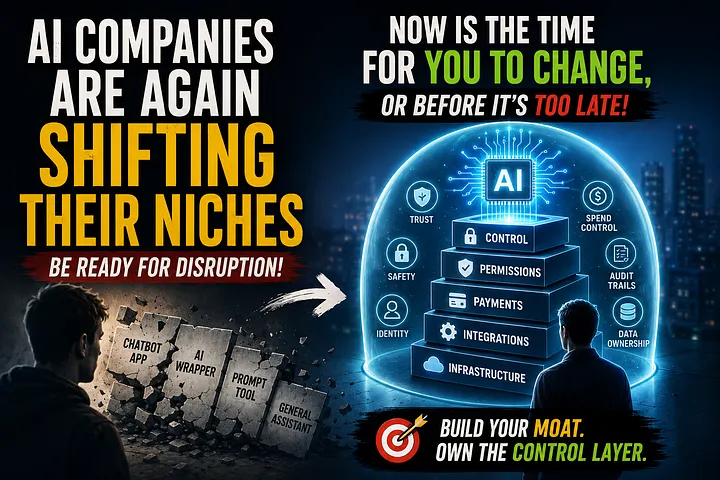
That’s why AI companies keep “shifting niches.” A model provider turns into an infrastructure company. A coding assistant turns into a permissions system. An open agent turns into a payments platform. A model wrapper turns into a sovereign stack.
These companies aren’t confused about what business they’re in. They’re racing toward the one part of the business that’s actually hard to copy.
And this shift is only going to get faster, not slower. Expect more “model” companies to start selling control instead: identity layers that verify which agent is acting on whose behalf, spend limits baked directly into infrastructure, and audit trails that exist by default instead of as an afterthought.
The companies that move early on this won’t look like AI companies anymore. They’ll look like security companies, payment companies, or compliance companies that happen to have a model attached.
What it means for YOU
What this means for you, depending on where you’re standing!
If you’ve built a thin product on top of someone else’s model, you’re exposed. Your users can swap that model out in a weekend, and the company behind it can rebuild your feature in an afternoon. A wrapper with no control layer of its own has a short shelf life.
If you’re a business adopting AI tools, you’re not just choosing a model anymore. You’re choosing who controls your data, your credentials, and your workflows. That choice matters more than which model wins this month’s benchmark.
If you’re building skills for the next decade, the safest bet isn’t memorising prompts. It’s understanding how permissions, guardrails, and integrations actually work, because that’s the layer every serious company is now fighting to own.
So how do you build your own moat before the ground shifts under you again?
Stop treating the model as your product. Start treating your workflow, your data, and the trust your users place in you as the product. A model can be swapped overnight. A workflow refined over two years of real user feedback, tied to real data and real guardrails, can’t.
Get as narrow as possible! None of the companies above won by being more general. Anthropic owns control of coding agents. Stripe is owning control for agent payments. Sarvam is betting on owning control for an entire country. Pick one specific problem you understand deeply, and own the control layer for that problem instead of chasing general intelligence.
Build the unglamorous parts on purpose. Permissions, approval flows, audit trails, credential handling. Nobody posts about these on social media. Everybody quietly depends on them.
And validate before you build any of it. Talk to five real users about what makes them hesitate to hand control to an AI system. Their hesitation is your roadmap**.**
None of this is really about guessing which company wins next quarter. It’s about noticing the pattern early enough that you’re not the one left holding a thin wrapper when the niche shifts again.
Most people will read this, nod,and keep building the exact same thing they were building yesterday.YOU don’t have to be most people.
Hey, thanks for reading this far. I’d genuinely like to hear where you think your own work sits in this shift, and what you’re doing to build a moat of your own.
More in artificial-intelligence




Cubed
Write about the technologies shaping the future.
For developers, founders, and curious minds exploring AI, crypto, Web3, and emerging tech—signal over noise.
One free account across In Plain English, Stackademic, Venture, and Cubed.
How it works- AI, crypto & Web3
- Software & emerging technologies
- Analysis & practical resources
- Thoughtful voices, not hype
Sign in
Google or GitHub
Complete profile
Takes a few minutes
Get approved & publish
Start sharing
Why write for Cubed?
The future deserves thoughtful voices, not just louder headlines.


Comments
Loading comments…