7 Post-Quantum Security Providers Protecting Layer-1 Blockchains in 2026
Quantum computers are closing in on the power to shred ECDSA and RSA keys. NIST has already named their replacements, and U.S. suppliers must migrate before 2030.
14 min read
Quantum computers are closing in on the power to shred ECDSA and RSA keys. NIST has already named their replacements, and U.S. suppliers must migrate before 2030. Every blockchain signature you create today could be forged tomorrow.
A new wave of post-quantum solutions is racing to protect those keys: some bolt dual signatures onto Bitcoin and Ethereum, others launch lattice-native chains, or embed quantum-safe keys in hardware modules.
In this guide, we rank the seven providers that matter in 2026—by cryptographic muscle, integration pain, speed hit, and audit pedigree—so you can act before qubits do.
Quantum computing vs blockchain: why the alarm bells are ringing
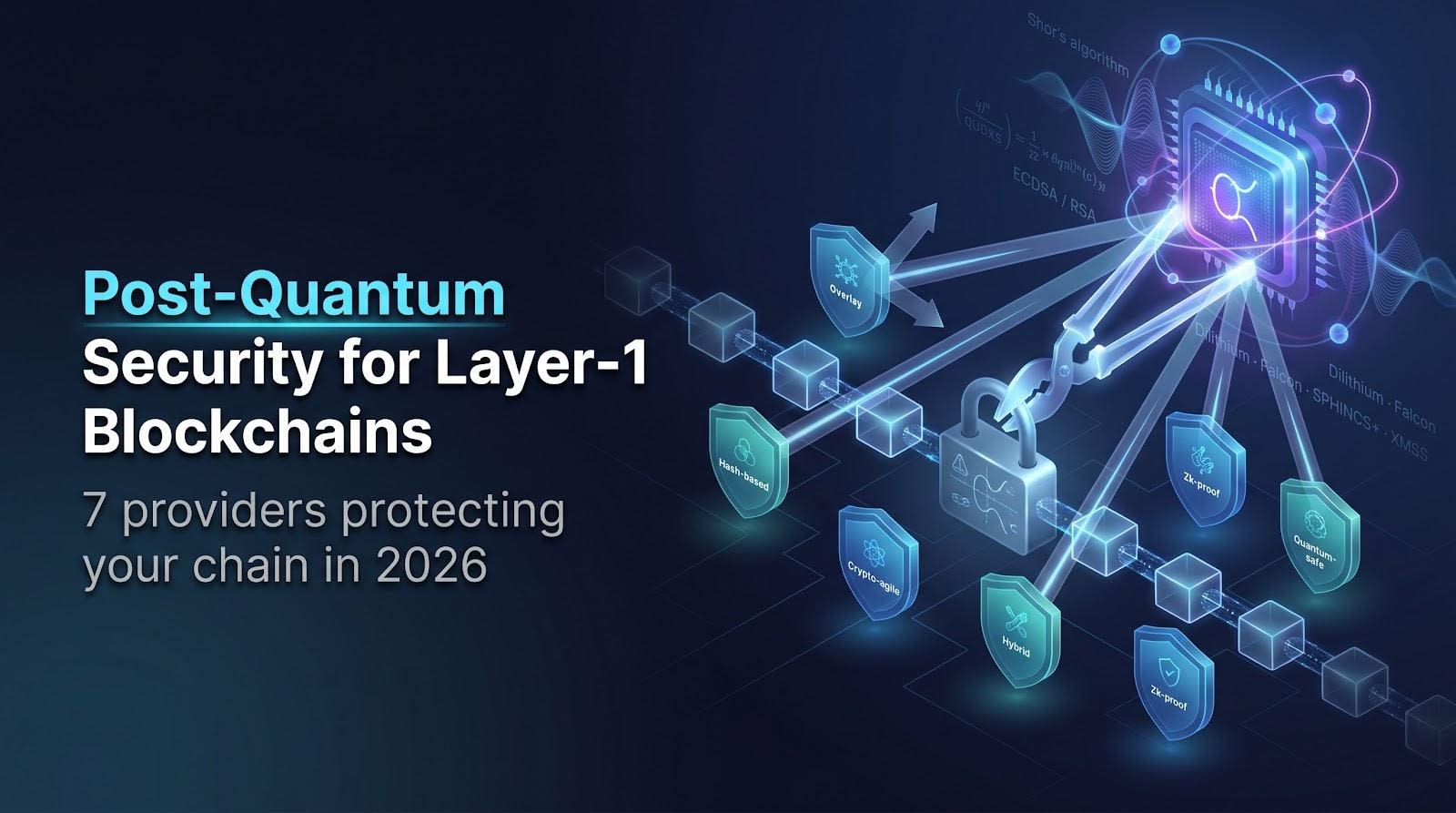
Imagine the cryptography that keeps Bitcoin and Ethereum secure as a padlock. Quantum computers are becoming bolt cutters shaped for that lock. Classical keys such as ECDSA and RSA overwhelm today’s chips, yet they look simple to qubits running Shor’s algorithm. Once hardware crosses the remaining thresholds, forging signatures can take a single weekend for a well-funded team.
Milestones are already on the board. Labs have cracked small RSA keys, and U.S. agencies require post-quantum upgrades across federal systems before 2035. Attackers can capture public keys and signed messages today, store them, then decrypt or re-sign once quantum gear matures. That harvest-now, decrypt-later tactic turns every long-lived blockchain into a repository of future vulnerabilities.
Digital signatures sit at the bullseye. If one is forged, an attacker can move funds, impersonate validators, or fork an entire chain. Encryption that guards messaging layers and zero-knowledge proofs must also evolve, yet signatures will fail first.
This deadline leaves two tactical questions for every protocol team: which replacement algorithms—lattice, hash, or hybrid—deliver the best security-performance trade-off, and how painful will migration be? Some networks test seamless overlays; others plan dual-signature rollouts that keep legacy keys alive until the new math proves itself. A few are rewriting everything and launching quantum-native chains.
The good news: NIST locked in a starter set of algorithms in 2024, so no one is waiting for standards anymore. Next, we walk through the six criteria we used to separate real solutions from press-release promises, then rank the seven providers you can deploy today.
How we evaluated the field
We didn’t toss names in a hat. Instead, we built a scorecard that mirrors the checkpoints your security team already trusts. A project had to clear all six questions below before it even entered the rankings.
First, does the solution rely on cryptography that passes NIST’s post-quantum gauntlet? No home-brew math. We looked for Dilithium, Falcon, SPHINCS+, or XMSS running in production code.
Second, how easily can you bolt it onto an existing stack? A drop-in SDK that shields a Bitcoin wallet beats a plan that needs a brand-new chain, long migrations, and downtime.
Third, what is the real performance hit? We favored networks or overlays that keep throughput above the 50-transactions-per-second floor that leading analysts flag as practical for enterprise workloads, as detailed in the Programming Insider comparison.
Fourth, is the code battle-tested or at least independently audited? Security through obscurity scored exactly zero points.
Fifth, does an active ecosystem back the tech? Frequent GitHub commits, recent funding, and enterprise pilots all counted.
Finally, can the solution pivot when standards evolve again? Crypto agility, defined as support for multiple algorithms and a clean upgrade path, matters because the post-quantum race is still running.
Each provider earned a High, Medium, or Low on those six lines, and the composite score decided its place on our list. No glossy deck could outweigh weak crypto or a history of unpatched bugs.
With the rules clear, let’s dive into the first contender and see how it measures up.
1. Project Eleven: quantum insurance for Bitcoin and Ethereum
Project Eleven tops our list because the team partners with protocols and critical infrastructure to audit signatures, co-develop migration playbooks, and roll out enterprise-grade post-quantum cryptography solutions that let you protect high-value wallets today without asking miners for a hard fork tomorrow.
Project Eleven Enterprise Post-Quantum Cryptography Solutions Website Screenshot
Its client runs in a secure enclave and signs each Bitcoin or Ethereum address with two NIST-approved keys: Dilithium for speed, and SPHINCS+ for belt-and-suspenders redundancy. Those proofs live in a public registry, so anyone can verify them without touching consensus rules.
Funding and transparency matter. The startup closed a USD 6 million seed round in 2025, and it published audited, open-source code before onboarding its first customer. Venture capital is not a security guarantee, yet it keeps engineers paid and patches flowing. More important, an independent audit means you are not taking the founders’ word for anything.
Integration is nearly friction-free. You keep your existing hot and cold wallets, add the Project Eleven plug-in, and the second signature travels as metadata. No new chain IDs, and latency stays flat because heavy crypto happens off-chain while the blockchain stores only a small proof hash.
Crypto agility is baked in. If future standards favor Falcon or a code-based scheme, you can rotate the secondary key while the Dilithium layer keeps running. That forward compatibility checks our final box and secures the number-one ranking.
Bottom line: if you hold assets on chains that move slower than quantum research, Project Eleven buys you time you cannot replace.
2. Quantum Resistant Ledger (QRL): security-first chain that plays the long game
Most blockchains plan to “add post-quantum someday.” QRL began there. Every wallet, transaction, and smart-contract call relies on XMSS, a hash-based signature scheme hardened by years of cryptanalysis. Without an elliptic curve to crack, a single quantum breakthrough cannot topple the chain.
Quantum Resistant Ledger XMSS Hash-Based Signature Architecture Diagram
Track record matters. QRL has moved real value since 2018 with zero signature incidents. Independent auditors reviewed the code before mainnet and after each major release. If your team equates uptime with trust, eight years of clean ledgers speak louder than any pitch deck.
Hash-based crypto has trade-offs. Signatures are larger, and each key pair works a limited number of times, so wallets handle address rotation behind the scenes. Throughput sits in the tens of transactions per second, not thousands, which is acceptable for a digital vault where permanence outranks speed.
Looking ahead, the roadmap adds lattice-based options and EVM compatibility, showing the team refuses to coast on early-mover status. The core promise stays intact: if quantum computers arrive tomorrow, QRL needs no emergency upgrade. For anyone issuing a tokenized bond, archiving an NFT, or managing long-term escrow, that peace of mind is hard to match.
3. QANplatform: quantum-ready smart contracts without leaving the EVM comfort zone
If you want Solidity familiarity plus quantum insurance, QANplatform hits a sweet spot. The chain swaps traditional elliptic-curve signatures for CRYSTALS-Dilithium, the flagship lattice algorithm selected by NIST. Under the hood the mechanics change, yet from a developer seat the workflow feels like Ethereum: spin up a node, deploy contracts, and call them through MetaMask on a ledger that shrugs off Shor’s algorithm.
Performance matters when signature sizes grow. QAN’s proof-of-stake engine sustains low-hundreds TPS on public test nets, well above our fifty-TPS baseline. The team credits that headroom to parallel validator pipelines and a compact Dilithium implementation in Rust.
Security is more than cryptography. In 2022 an attacker exploited the offline bridge contract, stealing about USD 2 million in tokens. The post-mortem was messy yet transparent, and new releases now route private keys through hardware security modules. Owning the mistake in public has given QAN a credibility boost many rivals still lack.
For builders, the draw is optionality. You can port an existing Solidity dApp almost verbatim or write business logic in any language that targets the Linux kernel—Go, C, or Python—via QAN’s polyglot toolkit. That breadth lowers hiring friction and speeds proofs of concept.
The roadmap promises more: an interop bridge to move ERC-20 assets onto the Dilithium ledger without custodial risk, and a confidential-compute module that signs zero-knowledge proofs with quantum-safe keys. If those features arrive on schedule, QANplatform could become the default playground for enterprises that need compliance-grade security and developer agility.
Trade-off to note: you still migrate assets to a new chain. If your board insists on “no chain swaps,” an overlay solution ranks higher. When green-field speed meets long-term crypto resilience, though, QANplatform deserves a spot near the top of any short list.
4. Algorand: a top-tier network already signing Falcon transactions
When most layer-ones talk quantum, they point to a roadmap. Algorand shipped code. In late 2025 engineers completed the first Falcon-signed payment on a high-throughput mainnet, proving the lattice algorithm can live inside tight performance targets.
Why does that milestone matter? A Falcon signature weighs about 1.3 KB, a rounding error in blocks that carry thousands of micro-payments. Verification stays fast, so validators still finalise blocks in seconds. Users saw no fee spike, no latency bump, only a quiet rise in cryptographic strength.
Algorand’s migration plan starts with choice. Developers can call a new opcode that verifies Falcon signatures in smart contracts today. Wallet providers can experiment without forcing every holder to rotate keys at once. When tooling matures, the network can switch consensus keys to Falcon through a governance vote, avoiding the drama that slows many hard forks.
Governance is a feature here. A research-driven foundation, professional validator set, and engaged community have already delivered multiple upgrades with minimal friction. That same structure can guide the full quantum cut-over well before quantum hardware scales.
If you need the liquidity of a top-30 chain but refuse to park assets on ageing crypto, Algorand delivers enterprise-grade speed and a live post-quantum on-ramp that works now, not later.
5. Hedera Hashgraph: enterprise governance ready for a quantum flip
Hedera views security from the boardroom. More than thirty blue-chip firms, including Google, IBM, and Boeing, sit on its governing council, and that corporate muscle shapes the network’s risk posture. Every validator node already runs inside certified hardware security modules. Firmware upgrades can swap Ed25519 keys for Dilithium as soon as vendor libraries clear testing, with no rewrite of consensus code.
Throughput is another headline. Hashgraph processes about ten thousand transactions per second with sub-second finality. Larger post-quantum signatures barely dent that ceiling because council nodes operate in data centers, not hobby rigs. For banks planning tokenised deposits or supply-chain platforms tracking millions of events, those numbers bring comfort.
Critics note the partial closed-source stack and permissioned validator set. Both are intentional choices. Hedera bets that clear governance and professional operations will matter more than decentralisation rhetoric when auditors ask who approved the migration plan. In a market where compliance teams hold the purse strings, that bet looks smart.
The roadmap places Dilithium support in a 2027 release window, with test-net trials slated for this year. The schedule aligns with United States federal mandates that require post-quantum readiness before 2030, so enterprise builders get a multi-year runway to integrate and certify.
If your chief information security officer values predictable change control over community drama, Hedera offers the calmest path to quantum safety on a public ledger.
6. XDC Network: phased migration that lets EVM apps stay put
XDC engineers chose pragmatism. They tested XMSS and SPHINCS+ in a sandbox and wired core contracts so an on-chain vote can swap algorithms without a hard fork. This phased plan allows the chain to settle payments with familiar ECDSA keys today and open quantum-safe addresses for early adopters tomorrow.
Sandbox results keep confidence high. Block finality remains close to two seconds, and trade-finance dApps pushing ISO 20022 messages have not noticed the added kilobytes because business documents already dwarf signature data. For workloads that prize reliability over microsecond latency, the overhead is noise.
Security teams like the gradual path. Users can migrate wallets at their own pace, regulators get an audit trail that proves quantum readiness, and, once confidence in the new math is universal, the network can flip the default signature scheme without downtime.
XDC’s enterprise DNA shows in standards support: native ISO 20022 fields, plug-in hooks for SWIFT gateways, and now a quantum-safe layer that checks forward-looking compliance boxes. If you need EVM compatibility but your board will not tolerate a risky chain swap, XDC’s phased migration offers the cleanest compromise on the market.
7. Nervos CKB: the crypto-agile sandbox for future algorithms
Most blockchains bake a signature scheme into consensus code. Nervos flips that model. On CKB, a signature is just another smart-contract script. Want ECDSA today? Deploy a script. Prefer Dilithium tomorrow? Publish a new one and point your wallet to it. Miners stay oblivious because the virtual machine runs whatever math you supply.
That design gives Nervos unmatched agility. If NIST crowns a Falcon successor in five years, CKB users can migrate funds with a simple script call while other chains schedule a hard fork. Developers already use a production SPHINCS+ lock script to build quantum-safe wallets without touching consensus.
Performance adapts to your needs. Vanilla transfers reach about 150 TPS. A heavy SPHINCS+ verify script costs more gas and trims throughput, but only for the accounts that choose it. The base layer keeps moving, so the network never slows users who stick with smaller keys.
Adoption remains the challenge. CKB hosts a committed developer crowd, yet total value locked trails the giants. Still, if your team wants to pilot post-quantum keys in production without waiting on core developers, Nervos offers a live playground. You can wrap Bitcoin in a bridge cell, lock it behind a Dilithium script, and rest easy knowing your hedge against Q-Day is already on-chain.
Bottom line: Nervos is the Swiss Army knife of signature schemes. If experimentation and upgrade freedom top your checklist, this is the toolkit to start with.
Side-by-side snapshot: how the seven stack up
| Provider | PQ algorithms | Integration effort | TPS hit | Audit / track record | Ecosystem strength | Crypto agility |
|---|---|---|---|---|---|---|
| Project Eleven | Dilithium, SPHINCS+ | Plug-in overlay | None | Open source, 2025 audit | Pilots with exchanges | High |
| QRL | XMSS (hash) | New layer-one migration | Moderate | Third-party audits; live since 2018 | Niche community | Medium |
| QANplatform | Dilithium | EVM-compatible layer-one | Low | Post-incident hardening | Growing developer base | Medium |
| Algorand | Falcon | Opcode add-on | Negligible | Formal verification culture | Top-30 chain | Medium |
| Hedera | Dilithium (scheduled) | HSM firmware swap | Negligible | SOC 2, council oversight | Enterprise council | Medium |
| XDC Network | XMSS, SPHINCS+ | Phased migration | Low | Code under review | Trade-finance users | High |
| Nervos CKB | Script selectable | Script deployment | Variable | Open source; six-year mainnet | Developer-heavy | Very High |
Conclusion
Key takeaways:
- Project Eleven wins on zero-friction rollout, which is why it leads the ranking.
- Algorand proves a high-cap chain can weave Falcon into production without slowing down.
- Nervos owns the flexibility column; if the standard shifts, you can publish a new script and move on.
FAQs: your quantum-resistant game plan, answered
How soon do we need to act?
Government deadlines land before 2030, yet the bigger risk is “harvest now, decrypt later.” Attackers can record your public keys today and forge signatures when quantum gear matures. Act early to avoid handing them that leverage.
Will post-quantum signatures slow my chain?
Not if you choose carefully. Lattice schemes such as Dilithium and Falcon add kilobytes, not megabytes, to each transaction. Algorand showed it can absorb the extra bytes without raising latency, cost, or finality.
Do we need a hard fork?
Only if your protocol cannot verify new keys in its current logic. Overlay tools like Project Eleven and phased migrations like XDC avoid fork drama. Crypto-agile designs such as Nervos let you swap algorithms with a script update.
What about wallets and hardware devices?
Major vendors test Dilithium firmware now. Until full support ships, many overlay solutions store the extra signature off-chain, so your Ledger or Trezor workflow stays familiar.
Can we mix algorithms for extra safety?
Yes. Dual signatures from unrelated families—lattice plus hash—create a fail-safe. If one scheme ever weakens, the other still stands.
More in blockchain

Cubed
Write about the technologies shaping the future.
For developers, founders, and curious minds exploring AI, crypto, Web3, and emerging tech—signal over noise.
One free account across In Plain English, Stackademic, Venture, and Cubed.
How it works- AI, crypto & Web3
- Software & emerging technologies
- Analysis & practical resources
- Thoughtful voices, not hype
Sign in
Google or GitHub
Complete profile
Takes a few minutes
Get approved & publish
Start sharing
Why write for Cubed?
The future deserves thoughtful voices, not just louder headlines.






Comments
Loading comments…