7 Must-Ask Questions Before You Hire Next.js Developers
10 min readDevang Chavda
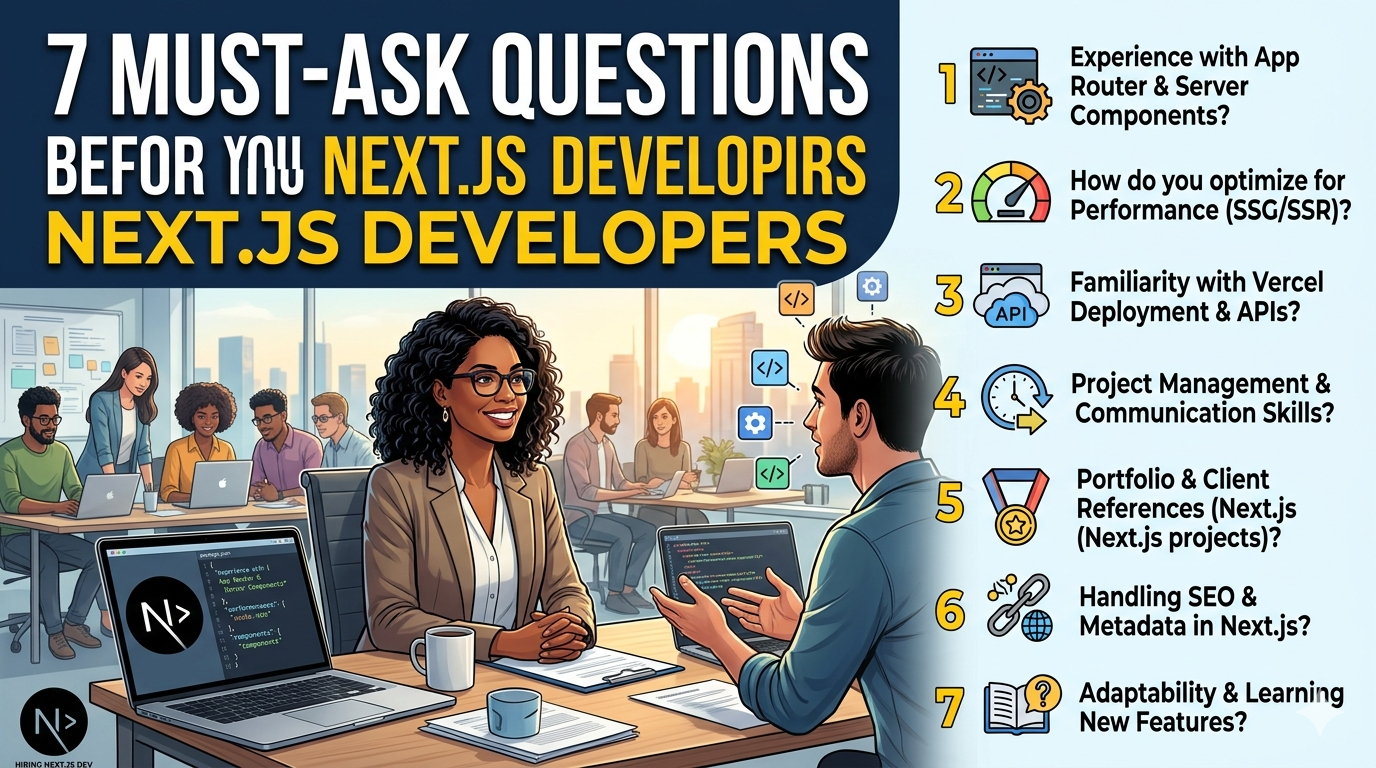
Next.js is now the platform of choice when it comes to high-performance web apps, and the market has reacted by hundreds of companies promoting Next.js experience. However, the difference between the purported Next.js functionality and actual functionality has been increasing, as the framework has changed — Server Components, the App Router, partial prerendering, and AI integration patterns have changed the appearance of competent Next.js development.
This guide has seven questions that aim at unearthing that gap prior to committing. They take the process of technical screening a step further to expose the way a group of people thinks about architecture, how they manage production issues, and how they keep abreast with a structure that changes at a pace faster than most developers can keep up with.
Ask all seven. The responses will do everything a portfolio page will not tell you.
Are You Constructing with the App Router and Server Components — and How do you determine What Renders Where?
This is the one most important technical question you can pose to a Next.js developer in 2026. The App Router and React Server Components are an architectural change of a paradigm where React applications are client-heavy to one where the server is the central element. Those developers who comprehend this change develop applications that are faster, smaller, and more performant. Those who fail to are constructing using an obsolete mental model of the framework.
What a robust answer discloses: The team describes their decision structure between server and client rendering, data-fetching elements render on the server to eliminate client-side network communication, interactive elements render on the client to enable responsiveness, and streaming with Suspense boundaries to display content gradually. They talk about certain trade-offs that they have made in production projects.
What a feeble response discloses: The team constructs all of it as client elements with a Next.js wrapper, considers Server Components optional, or lacks the ability to describe when to employ either of the rendering options. This implies they have learned Next.js prior to the change in architecture and have not modernized.
What Do You Do to Measure and Maintain Performance throughout the Application Lifecycle?
Next.js makes fast applications possible. It does not turn them automatic. Performance must be carefully measured and maintained against degradation as features are added.
What an excellent response shows: The team explains certain metrics they monitor, including Largest Contentful Paint, Interaction to Next Paint, Cumulative Layout Shift, and how they monitor them. To prevent regressions, they run Lighthouse or Web Vitals checks in CI/CD pipelines. They perform frequent bundle analysis in order to determine redundant JavaScript. They are able to share performance information of applications they have developed.
What a feeble response betrays: Performance is viewed as something that is put at the close of a project or when complaints are raised. There is no surveillance system in place. There is no available performance data of past projects. This forecasts applications which start quickly and degrade with each new feature release.
What Has Your experience with AI integration in Next.js been?
In 2026, much of this new Next.js work will also feature AI features — conversational interfaces, intelligent search, content generation, recommendation systems, or agentic AI dashboards. The server-first structure of the framework allows it to be especially useful when working with AI, though to use the opportunity, one has to have certain experience.
What a powerful answer demonstrates: The team explains production experiences in which they used Server Components to implement calls to the API of the AI server-side, streamed AI responses to React interfaces with the Vercel AI SDK or similar tooling, implemented AI-specific UX patterns like progressive loading and error recovery, and had cost control strategies to use AI API.
What a flimsy response tells us: AI experience is restricted to invoking one API endpoint, without streaming, caching or security concerns. None of the immediate injection prevention, or cost optimization. This gap will either require rearchitecting or recruiting a second team in case AI features are on your roadmap.
Python services are usually paired with Next.js in applications where the AI layer uses custom model training or requires complicated data pipelines. The discussion of [top Python development companies] (https://www.webcluesinfotech.com/python-development-companies/) gives some background on companies that build Next.js frontends with Python-based AI backends — a popular architecture used to build intelligent web app.
What is your approach to Caching and data revalidation?
Next.js offers powerful yet complicated caching options request memoization, data cache, full route cache and router cache. One of the most frequent causes of bugs in Next.js applications is a misconception of these layers so that users can see outdated information or that changes do not manifest themselves at all.
What a robust answer shows: The team describes every caching layer, how they revalidate (time based or on-demand) and how they had to debug caching problems in production. They possess a clear mental picture of the time data is stored in cache, the location of the data in the cache and how to invalidate it in a reliable manner.
What a flawed response tells you: Caching is passively maintained — the team uses defaults of the frameworks without any insight. This leads to applications in which stale data is returned unexpectedly and debugging is more time-consuming than it needs to be due to the team not knowing the caching architecture that they are running on.
What is the Deployment and Infrastructure Setup?
Applications written in Next.js can be deployed to either Vercel or AWS, or to self-hosted Node.js servers or containerized applications. Both alternatives are associated with various trade-offs regarding the cost, control, capabilities of edges, and operational complexity.
What a powerful reply brings forth: The team considers the deployment options depending on your specific needs and not falls to one platform. They address trade-offs between self-hosted and infrastructure managed by Vercel. Environment configuration, secrets management, CI/CD pipelines, and monitoring are all common aspects of their delivery.
What a poor response signifies: The team will only deploy on a single platform without thinking of it, or they will create applications but will leave you to take care of deployment and infrastructure. Both show gaps that will have an impact on the operational reliability of your project.
What is your approach to testing in Next.js Applications?
Next.js presents many challenges to testing, including Server Components that must be rendered on the server cannot be tested with typical client-side testing tools, API routes must be tested with integration testing, and server and client rendering create edge cases not covered by standard React testing.
What a powerful answer shows: The team has a layered testing approach, consisting of business logic and utility tests, API routes and server action tests, component tests of both server and client tests with the right tools, and end-to-end tests of key user scenarios. In CI/CD, tests are automatically run and in block deployment, they fail.
What a poor response tells us: This is a generic description of testing without trying to answer Next.js-specific challenges. No server and client component testing. No automated pipeline. Testing as a stage and not a practice.
What about Next.js Version Upgrades and Breaking Changes?
Next.js releases new updates regularly, and they may have breaking changes or new patterns that will impact application architecture. The way a team manages the evolution of its framework has a direct impact on the health of your application in the long term.
What a powerful response will tell us: The team is connected to the Next.js releases, analyzes the new features in terms of their relevance to customer projects, and plans to upgrade the work as a part of regular maintenance. They explain certain upgrades they have made — moving away Pages Router to App Router, introducing Server Components to an existing application, or partial prerendering — and the difficulties they have met.
What a feeble response shows: Upgrades get indefinitely postponed or done when something goes wrong. No active tracking of the change of frameworks. This leads to applications that become increasingly out of date with best practices and ultimately need costly catching up migrations.
Applications of these questions.
Ask each of the seven to each candidate. Comparability is made possible by consistency. Missing questions to applicants who appear to be excellent candidates compromises the assessment.
Answers to a specificity scale. Strong answers are named tools, specific metrics, concrete examples of past projects, and truthful recognition of challenges. Weak answers are based on commitment, generalizations, and theoretical knowledge devoid of evidence in production.
Hear what they request in reverse. The top Next.js developers pose clarifying questions — regarding your performance needs, deployment choices, AI roadmap, and user scale. When a candidate goes through the seven questions and does not ask a question of his/her own, then he is performing rather than engaging.
Compare side by side after each conversation. Note down main points of each conversation at the time. Trends emerge when you look through the notes of the candidates — what teams were precise and what were imprecise, which ones were straightforward about constraints and which claimed everything.
Frequently Asked Questions
What are the questions that I should ask prior to hiring Next.js developers?
Inquire about their experience with the App Router and Server Component, their practices with performance measurement, their ability to integrate AI, and their caching and revalidation strategies, their method of deploying infrastructure, their testing approach to Next.js-specific challenges, and how they upgrade their framework version.
What can I tell about whether a Next.js developer is knowledgeable about current patterns?
Enquire about Server Components and Client Components and their decision framework. Server-first rendering, streaming using Suspense, partial prerendering and Server Action will be spoken about by developers who are familiar with modern Next.js. The current architecture is not adopted by those who describe client-side React mostly using Next.js routing.
In 2026, what is the cost of hiring Next.js?
Offshore and nearshore developers cost between $40 and nine5 an hour, whereas the US and European talent cost between 110 and 230 an hour. Project based activities normally cost between 30–200000 dollars based on complexity. Projects built with Next.js and AI end up in the higher end of these scales.
Which question should I consider the most significant to ask a Next.js developer?
The most diagnostic single question is Question 1 — regarding App Router and Server Component rendering choices. It instantly shows whether a developer is aware of the architectural change that characterizes the modern Next.js development or is dealing with patterns of the past.
Is AI integration knowledge that Next.Js developers need to possess as well?
Increasingly, yes. Another notable and increasing proportion of Next.js applications in 2026 will have AI-generated functionality. Those developers who are knowledgeable of server-side integration of LLM, streaming of responses, and AI-specific UX patterns can provide more complete solutions as compared to developers who need a different team to work on AI.
Seven Interrogatives, One Indication.
These questions are not meant to be knowledge-testing. They are created to demonstrate the way a developer thinks, works, and keeps up in a system that requires constant learning. Those who respond with details, illustrations and frank discussion of issues will be the ones that can perform when the project hits the complexity of the real world that no specification can possibly foresee.
Ask all seven. Trust the evidence. And get the Next.js developers whose responses reflect depth as opposed to mere familiarity.
More in nextjs


Cubed
Write about the technologies shaping the future.
For developers, founders, and curious minds exploring AI, crypto, Web3, and emerging tech—signal over noise.
One free account across In Plain English, Stackademic, Venture, and Cubed.
How it works- AI, crypto & Web3
- Software & emerging technologies
- Analysis & practical resources
- Thoughtful voices, not hype
Sign in
Google or GitHub
Complete profile
Takes a few minutes
Get approved & publish
Start sharing
Why write for Cubed?
The future deserves thoughtful voices, not just louder headlines.


Comments
Loading comments…