5 Surprising Lessons from The Art of War That Have Nothing to Do with War
6 min readSouvik Misra
Introduction: The Wisdom You Weren’t Expecting
For over 2,500 years, Sun Tzu’s The Art of War has been the definitive text on military strategy. Its pages are often associated with ruthless tactics and aggressive conflict, a manual for conquering opponents through force. But this common perception misses the book’s most profound and enduring genius.
The true core of The Art of War is not about fighting; it’s about the psychology of conflict itself. Sun Tzu’s greatest lessons are deeply counter-intuitive principles about preparation, strategic positioning, and the masterful art of avoiding direct confrontation. He teaches that the most brilliant victories are not won on the battlefield, but in the minds of the commanders long before any armies clash.
This article explores five of the most surprising takeaways from this ancient classic — principles that reveal a more subtle and powerful path to success in any competitive field. We have deep-dived more on this in this video https://t.co/lmdsootKeW
1. The Greatest Victory is Winning Without a Fight
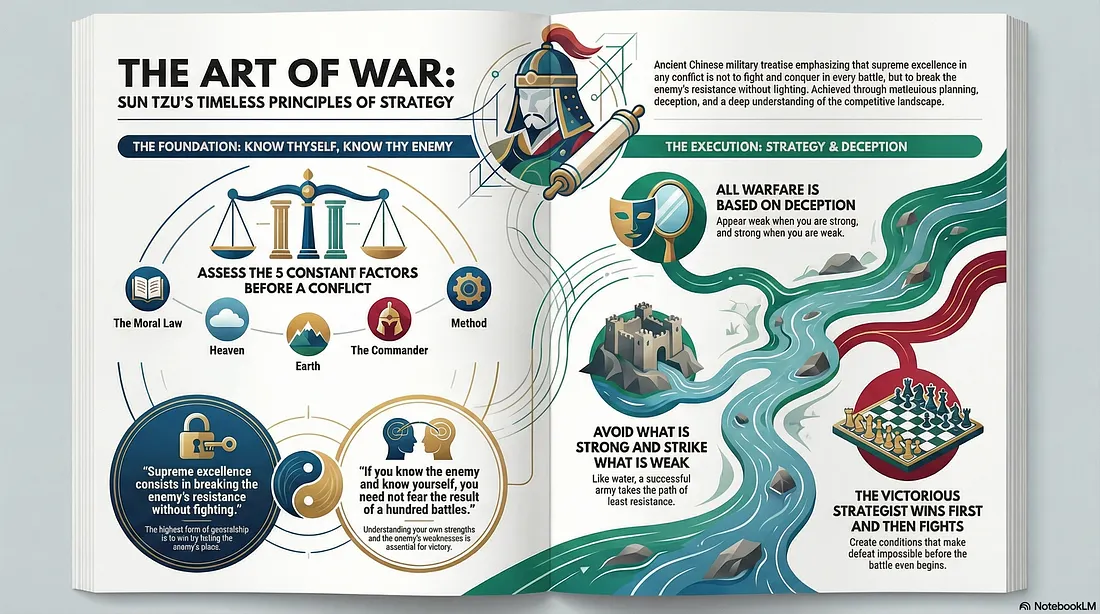
The central, and perhaps most shocking, principle of The Art of War is that the ultimate achievement is to subdue an opponent without ever engaging in battle. Sun Tzu consistently prioritizes strategy over brute force. He argues that taking an enemy’s country “whole and intact” is vastly superior to destroying it, and the “highest form of generalship is to balk the enemy’s plans” before they can ever be put into action.
This reframes the entire goal of conflict. It is not about destruction, but about strategic submission. The aim is to make your opponent’s resistance futile or irrelevant through superior planning and positioning, forcing them to yield without a single blow. This lesson, applicable in business, negotiation, and personal strategy, teaches that true mastery lies in making the fight itself unnecessary.
Hence to fight and conquer in all your battles is not supreme excellence; supreme excellence consists in breaking the enemy’s resistance without fighting.
2. The Most Brilliant General Earns No Fame
In a world that celebrates heroic, hard-won victories, Sun Tzu offers a startlingly different definition of excellence. He argues that the most skillful leaders win so easily and subtly that their triumphs go completely unnoticed by the public. True brilliance is not found in the dramatic battles that cause “the whole Empire says, ‘Well done!’”
According to Sun Tzu, the greatest strategist foresees and neutralizes threats before they ever materialize. Their success looks effortless, even like a non-event, because they engage only when the conditions for victory are overwhelmingly assured. They win by “conquering an enemy that is already defeated.” This challenges our modern love for heroic narratives, suggesting that the most effective leaders are not those who solve crises, but those who prevent them from ever happening.
Hence his victories bring him neither reputation for wisdom nor credit for courage.
3. Sometimes, You Must Ignore the Rules (and Your Boss)
Sun Tzu makes a radical assertion that subordinates rigid authority to the fluid reality of the situation on the ground. He states that a general in the field must have the autonomy to adapt to changing circumstances, even if it means directly disobeying orders from the sovereign.
He explicitly lists “commands of the sovereign which must not be obeyed” as a key tactical consideration for any leader. The principle is clear: the commander on the front lines, possessing real-time information, is in the best position to make critical decisions. This is a timeless lesson on the importance of empowering experts and valuing situational awareness over blind adherence to a predetermined plan. Success requires flexibility, not just obedience.
4. Always Leave Your Enemy an Escape Route
One of the most counter-intuitive pieces of advice in the book is to provide a surrounded enemy with an outlet for escape. Logic might suggest that trapping an opponent completely is the surest way to destroy them, but Sun Tzu understood the deep psychological risks of such a move.
The reasoning is a masterclass in managing an opponent’s state of mind. A cornered foe, with nothing left to lose, becomes a “desperate foe.” They will fight with an unexpected and ferocious intensity born from the “courage of despair.” The object, as the ancient commentator Tu Mu puts it, is “to make him believe that there is a road to safety, and thus prevent his fighting with the courage of despair.” Then, Tu Mu adds with chilling clarity: “After that, you may crush him.” By leaving an escape route, a commander prevents a fight-to-the-death mentality from taking hold, turning a potential bloodbath into a controlled retreat.
When you surround an army, leave an outlet free.
5. Deception Isn’t Just a Tactic — It’s the Foundation of Strategy
While many view deception as a single tool in a strategist’s arsenal, Sun Tzu presents it as the fundamental basis of all warfare. The entire engagement is a mental battle before it is ever a physical one. His strategy is built on manipulating the enemy’s perception of reality.
He provides clear examples: seem unable when you are able, appear inactive when you are using your forces, make the enemy believe you are far when you are near, and near when you are far. This extends to psychological tactics, such as irritating a “choleric” opponent to provoke rash decisions or feigning weakness to encourage arrogance. This principle is timeless. As military historian Colonel Henderson noted, the great Duke of Wellington was distinguished by “the extraordinary skill with which he concealed his movements and deceived both friend and foe.” For Sun Tzu, conflict is not a contest of strength, but a contest of perception. The leader who controls what the enemy sees and believes controls the outcome.
All warfare is based on deception.
Conclusion: A Timeless Guide to Smarter Conflict
The Art of War endures not as a simple manual for fighting, but as a profound guide to the psychology of strategic engagement. Its most powerful lessons are not about crushing your enemies, but about out-thinking, out-maneuvering, and psychologically mastering any competitive situation. It teaches that victory is a product of superior preparation and insight, not just superior force.
The wisdom of Sun Tzu forces us to re-examine our approach to confrontation in all aspects of life. It leaves us with a critical question: How might we approach our own challenges differently if our primary goal was not to win the battle, but to make the battle unnecessary?
More in business-strategy
Cubed
Write about the technologies shaping the future.
For developers, founders, and curious minds exploring AI, crypto, Web3, and emerging tech—signal over noise.
One free account across In Plain English, Stackademic, Venture, and Cubed.
How it works- AI, crypto & Web3
- Software & emerging technologies
- Analysis & practical resources
- Thoughtful voices, not hype
Sign in
Google or GitHub
Complete profile
Takes a few minutes
Get approved & publish
Start sharing
Why write for Cubed?
The future deserves thoughtful voices, not just louder headlines.


Comments
Loading comments…