The Ghost in the Machine: How AI Actually “Creates” Text, Art, and Sound
6 min readZainab Ikhwan
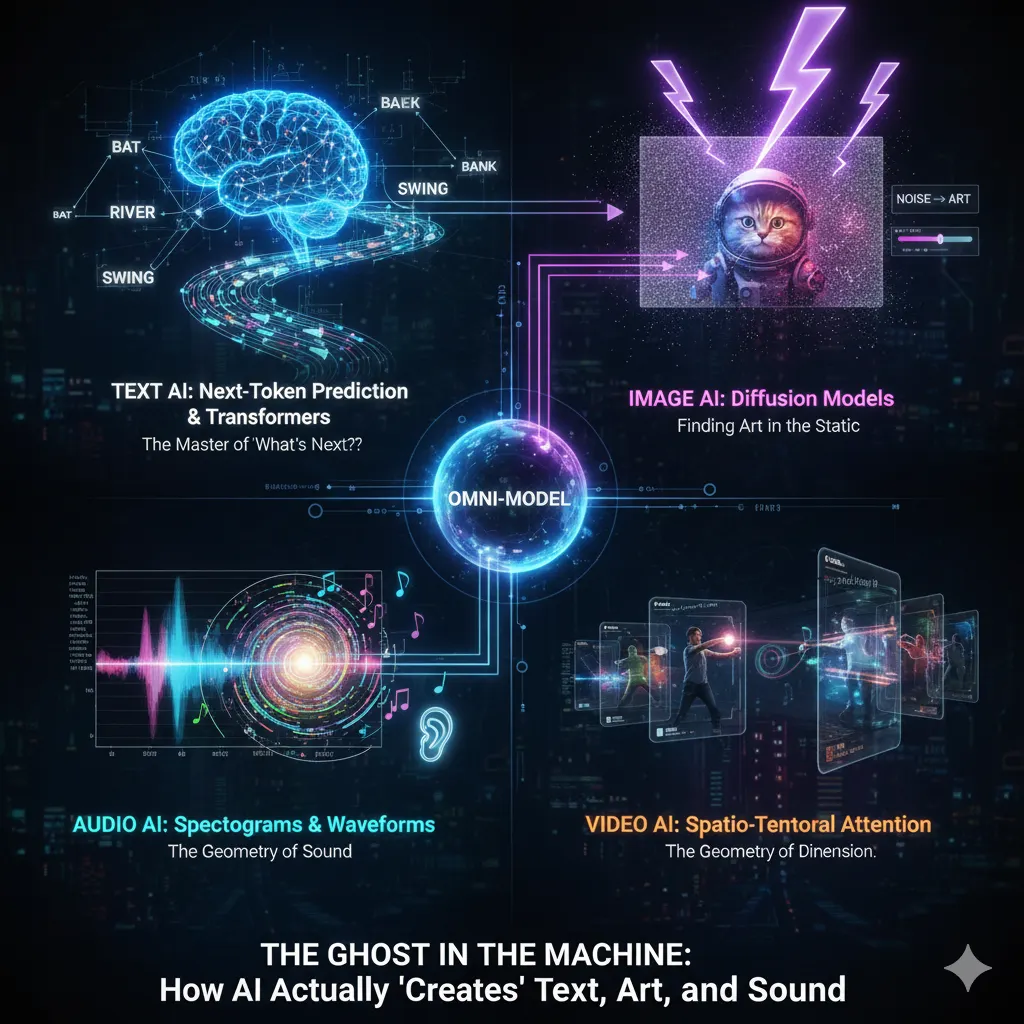
For most of us, using AI feels like casting a spell. You type a few words into a box, and — poof — a Shakespearean sonnet appears, or a photorealistic image of a cyberpunk city, or even a hauntingly beautiful cello concerto.
But behind that digital curtain, there isn’t a sentient brain dreaming up ideas. There is no “ghost in the machine.” Instead, there is a breathtakingly complex symphony of math, geometry, and probability.
If you’ve ever wondered how a computer actually “understands” a sunset or “hears” a melody, let’s pull back the curtain. Here is the science of how the different flavors of AI actually work in 2026.
1. Text AI: The World’s Most Advanced Game of “What’s Next?”
When you talk to a Large Language Model (LLM), it isn’t “thinking.” It is predicting.
The core of modern text AI is a piece of architecture called the Transformer. Think of it like a librarian with a photographic memory of every book ever written. To this librarian, words aren’t letters; they are Tokens.
The Science of Attention
The real “magic” ingredient is something called Self-Attention. In the past, computers struggled with context. If you said, “The bat flew out of the cave,” and then said, “The player swung the bat,” an old computer might get confused.
A Transformer uses math to “attend” to the other words in the sentence. When it sees “bat,” it looks at the surrounding words. If it sees “cave” and “flew,” it assigns a mathematical weight that links “bat” to the biological animal. If it sees “player” and “swung,” the weights shift toward the sporting equipment.
By doing this billions of times per second, the AI predicts the next most likely token. It’s like the “autofill” on your phone, but with the processing power of a thousand supercomputers.
2. Image AI: Finding Order in the Chaos
If text AI is a librarian, Image AI (like Midjourney or DALL-E) is a sculptor. Specifically, a sculptor who works with digital “marble” made of static.
Most of the images you see today are created through a process called Diffusion. To understand this, imagine taking a clear photo of a dog and slowly adding grains of salt (digital noise) until the dog disappears and you’re left with a screen of grey static.
Un-Breaking the Image
The AI is trained by watching this process in reverse. It studies billions of pairs of images and their descriptions. It learns that if a pile of static has a certain “clump” of pixels and the prompt says “dog,” it should nudge those pixels to look more like an ear or a nose.
When you give it a prompt, the AI starts with a canvas of pure random noise. It then “denoises” the image in steps. It looks at the static and asks, “Based on the prompt ‘A golden retriever in a hat,’ which of these random grey dots looks most like a hat?” It cleans those dots up, moves to the next layer, and repeats the process until a sharp image emerges from the fog.
3. Audio AI: Painting with Soundwaves
Audio is arguably the hardest medium for AI because sound is incredibly “dense.” A single second of high-quality audio contains 44,100 individual data points.
To handle this, AI doesn’t usually “listen” to soundwaves. It looks at them. It converts sound into a Spectrogram — a visual map where the vertical axis is pitch, the horizontal is time, and the brightness is volume.
The Geometry of Music
Once the sound is a “picture,” the AI can use similar logic to Image AI.
- For Voice: The AI learns the “texture” of a human voice — the tiny vibrations and pauses that make you sound like you.
- For Music: It learns the mathematical relationship between notes. It knows that in a blues song, a specific chord is likely to follow another.
In 2026, we’ve moved into Neural Audio Synthesis, where the AI can generate the actual raw waveform bit-by-bit, allowing it to “sing” with emotion or create instruments that don’t even exist in the physical world.
4. Video AI: The Final Frontier (Adding the 4th Dimension)
Video AI is the “Final Boss” of Machine Learning. It requires everything we just discussed — text understanding, image generation, and audio — plus a new element: Temporal Consistency.
If an AI generates a video of a man walking, it has to ensure that his shirt doesn’t change color from frame 1 to frame 24. It has to understand physics.
Spatio-Temporal Attention
Modern video models use “Spatio-Temporal Attention.” This means the AI isn’t just looking at the pixels in the current frame (Space); it’s looking at the pixels in the frames before and after it (Time).
It creates a “latent space” — a mathematical playground where it simulates how objects move. If a ball is thrown in frame 1, the AI calculates the arc it should follow in frame 10. It is, in a very literal sense, a “world simulator.” It isn’t just drawing pictures; it’s trying to predict how the physical world behaves.
Why Does the “How” Matter?
Understanding the science behind AI changes how we interact with it. When we realize that AI is a probabilistic engine, we stop expecting it to be “correct” in the way a calculator is. We start to see it as a creative partner — a mirror of human data that can help us explore new ideas.
It also helps us spot the limitations. AI struggles with “fingers” in images or “logic” in text because it doesn’t have a skeleton or a soul; it has a map of correlations. It knows that fingers usually appear in groups of five, but it doesn’t “know” what a hand is.
The Future: Multi-Modal Harmony
As we move through 2026, these separate “brains” are merging. We are entering the era of Omni-models — single AI systems that don’t need to convert text to image or image to audio. They “understand” all these mediums simultaneously, much like a human does.
When you see a video of a crackling fire, you can almost “smell” the smoke and “feel” the heat because your brain connects those senses. AI is finally starting to do the same.
Summary Checklist: The AI “Cheat Sheet”
- Text AI = Probability + Context (Transformers)
- Image AI = Sculpting order out of static (Diffusion)
- Audio AI = Mapping frequencies as pictures (Spectrograms)
- Video AI = Simulating physics and time (Temporal Consistency)
More in artificial-intelligence


Cubed
Write about the technologies shaping the future.
For developers, founders, and curious minds exploring AI, crypto, Web3, and emerging tech—signal over noise.
One free account across In Plain English, Stackademic, Venture, and Cubed.
How it works- AI, crypto & Web3
- Software & emerging technologies
- Analysis & practical resources
- Thoughtful voices, not hype
Sign in
Google or GitHub
Complete profile
Takes a few minutes
Get approved & publish
Start sharing
Why write for Cubed?
The future deserves thoughtful voices, not just louder headlines.
Comments
Loading comments…